







Question: Learning Goal: To section a composite shape into simple shapes so the moment - ofinertia tables and the parallel - axis theorem can be used
Learning Goal:
To section a composite shape into simple shapes so the momentofinertia tables and the parallelaxis theorem can be used to find the moment of inertia of the composite shape.
Tables listing moments of inertia cannot contain the formula for every possible shape that can be built. However, many shapes can be sectioned into pieces that have entries in the tables. Consider the shape in the following figure,
Figure
This shape can be sectioned into three rectangles as so
Figure
Because the moment of inertia of a rectangle is a wellknown formula, the moment of inertia for the full composite can be found by calculating the individual moments of inertia of the three sections and adding them. Because the centroids of the vertical sections do not align with the x or y axes, we will need to use the parallelaxis theorem to calculate the moments of inertia of those sections. The moment of inertia for a crosssection where the centroid of the crosssection does not align with the reference axis is given by
IbarIA d
where barI is the moment of inertia of the crosssection with respect to its centroid, A is the area of the crosssection, and d is the perpendicular distance from the reference axis to the centroid of the crosssection.
Because the principle of superposition applies to moments of inertia, we are free to section a shape in any way we like, provided no part of the shape is left out or contained in more than one section. The original shape could have been sectioned in the following manner,
Figure
and the calculated moment of inertia for the composite would have been the same. Part of the "art" of finding the moment of inertia of a composite shape is determining how to section the shape. For example, if the moment of inertia about the y axis were needed, the first sectioning would be better. The second sectioning makes calculating the moment of inertia about the x axis easier.
For this tutorial, you will need the following moments of inertia:
Figure
Correct
Part B Moment of Inertia of a Composite Beam about the y axis
For the beam from Part A shown again here for reference calculate the moment of inertia about the y axis.
Figure
The dimensions are dmathrmin dmathrmin dmathrmin and tmathrmin
Express your answer to three significant figures and include the appropriate units.
View Available Hints
Incorrect; Try Again; attempts remaining
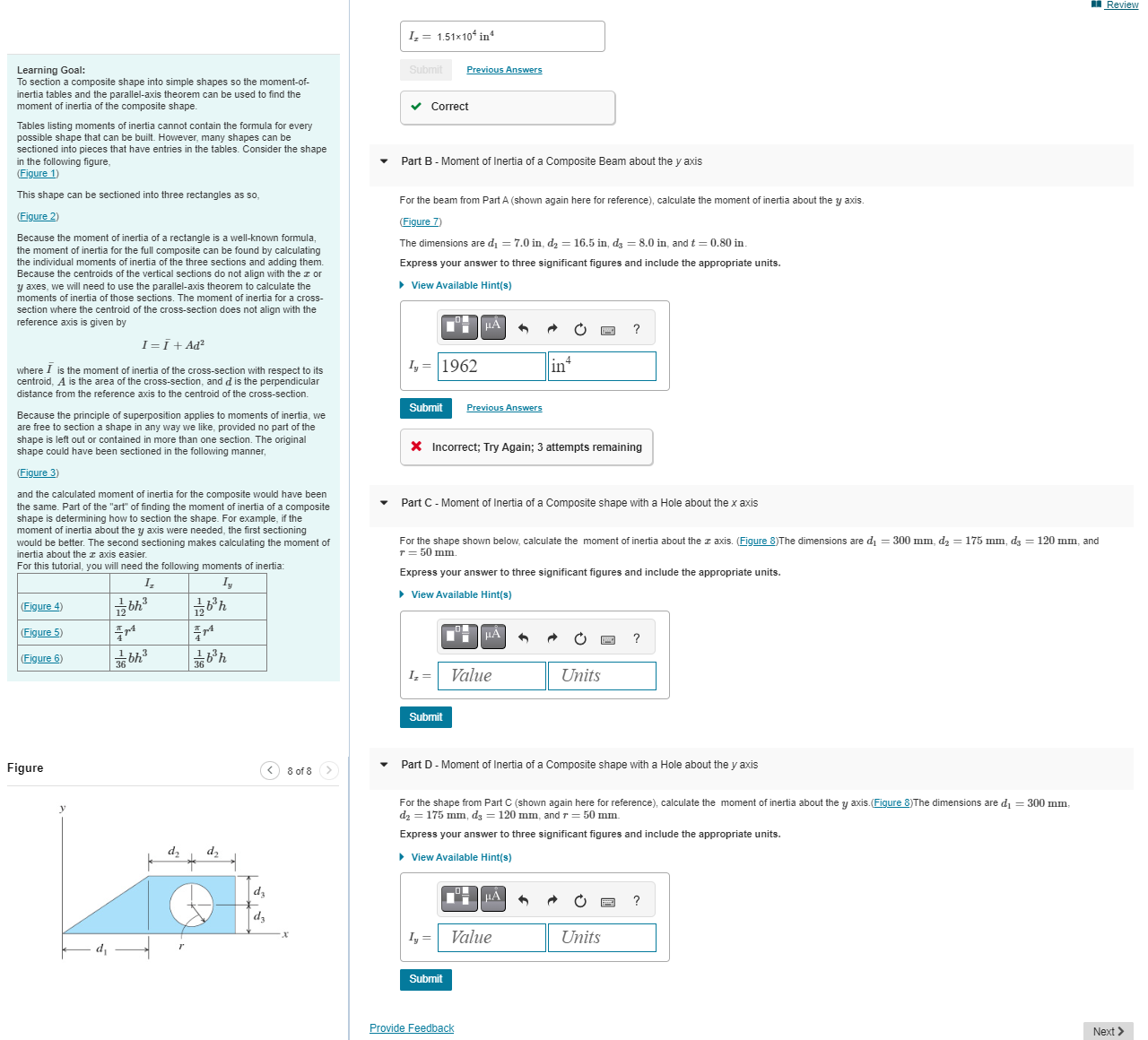
Part C Moment of Inertia of a Composite shape with a Hole about the x axis
For the shape shown below, calculate the moment of inertia about the x axis. Figure The dimensions are dmathrm~mm dmathrm~mm dmathrm~mm and rmathrm~mm
Express your answer to three significant figures and include the appropriate units.
View Available Hints
Izsquare
Part D Moment of Inertia of a Composite shape with a Hole about the y axis
For the shape from Part C shown again here for reference calculate the moment of inertia about the y axis.Figure The dimensions are dmathrm~mm dmathrm~mm dmathrm~mm and rmathrm~mm
Express your answer to three significant figures and include the appropriate units.
View Available Hints
Iysquare
Step by Step Solution
There are 3 Steps involved in it
1 Expert Approved Answer
Step: 1 Unlock

Question Has Been Solved by an Expert!
Get step-by-step solutions from verified subject matter experts
Step: 2 Unlock
Step: 3 Unlock
 Study Help