







Question: Learning materials 1. What leads to lower consumer spending? a) Lower revenue b) Tax reduction c) Expectation of rapid price increases d) Increase in state
Learning materials
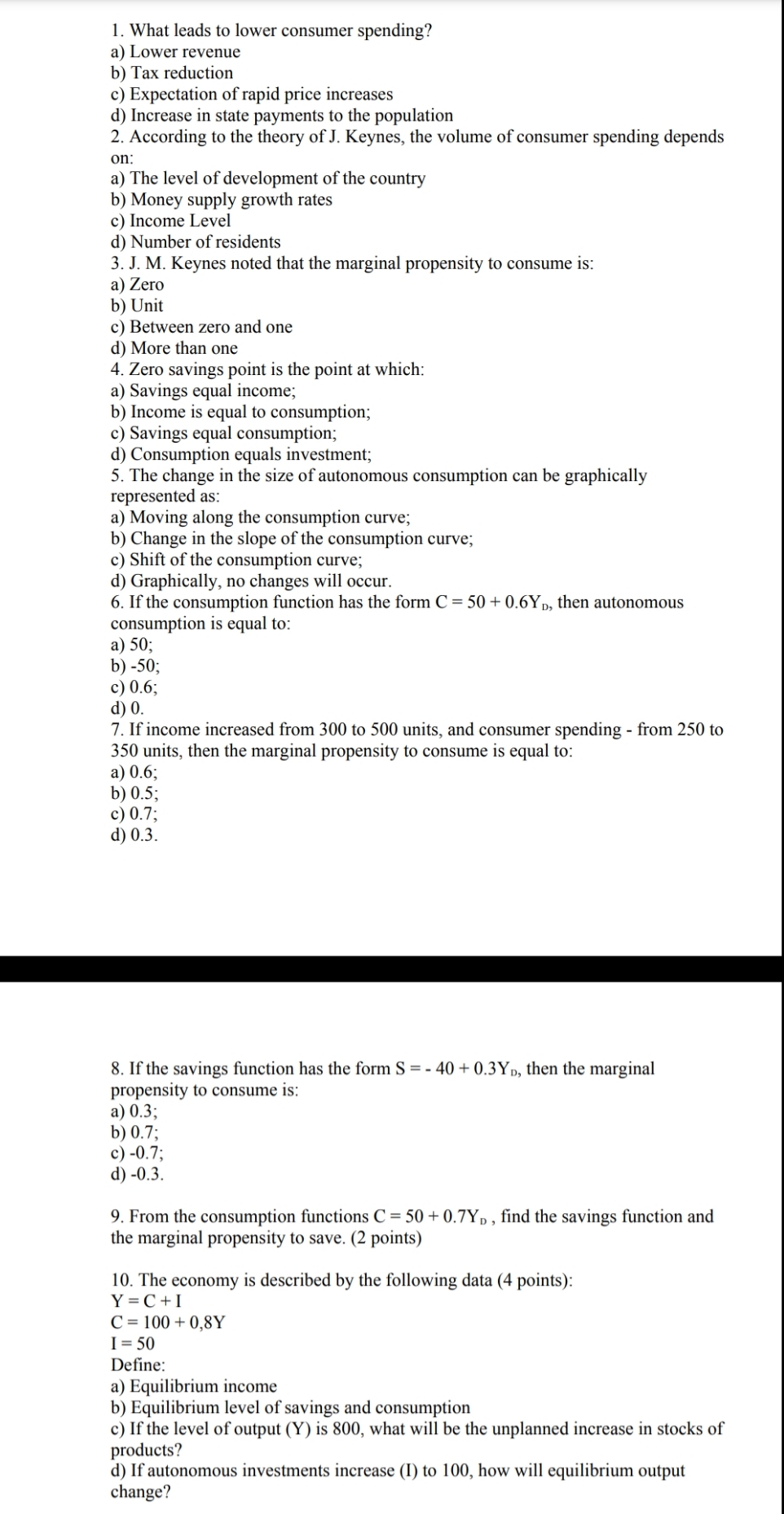
1. What leads to lower consumer spending? a) Lower revenue b) Tax reduction c) Expectation of rapid price increases d) Increase in state payments to the population 2. According to the theory of J. Keynes, the volume of consumer spending depends on: a) The level of development of the country b) Money supply growth rates c) Income Level d) Number of residents 3. .l. M. Keynes noted that the marginal propensity to consume is: a) Zero b) Unit c) Between zero and one d) More than one 4. Zero savings point is the point at which: a) Savings equal income; b) Income is equal to consumption; c) Savings equal consumption; d) Consumption equals investment; 5. The change in the size of autonomous consumption can be graphically represented as: a) Moving along the consumption curve; b) Change in the slope of the consumption curve; c) Shift of the consumption curve; d) Graphically, no changes will occur. 6. If the consumption function has the form C = 50 + 0.6YD, then autonomous consumption is equal to: a) 50; b) -50; c) 0.6; d) 0. 7. If income increased from 300 to 500 units, and consumer spending - from 250 to 350 units, then the marginal propensity to consume is equal to: a) 0.6; b) 0.5; c) 0.7; d) 0.3. 8. If the savings function has the fortn S = - 40 + 0.3Yn, then the marginal propensity to consume is: a) 0.3; b) 0.7; c) -0.7; d) -0.3. 9. From the consumption inctions C = 50 + 0.7YD , nd the savings function and the marginal propensity to save. (2 points) 10. The economy is described by the following data (4 points): Y = C +1 C = 100 + 0,8Y 1= 50 Dene: a) Equilibrium income b) Equilibrium level of savings and consm'nption c) If the level of output (Y) is 800, what will be the unplanned increase in stocks of products? d) [f autonomous investments increase (I) to 100, how will equilibrium output change
Step by Step Solution
There are 3 Steps involved in it

Get step-by-step solutions from verified subject matter experts
 Study Help