Question: Learning Objectives and Key Terms Instructions: Review the Chapter 3 Learning Objectives and key terms below. Learning Objectives to understand the characteristics of distributive bargaining
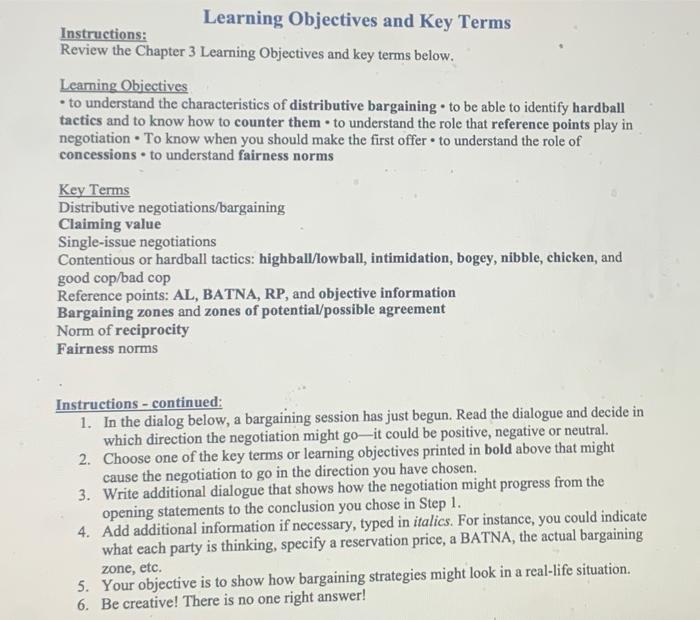
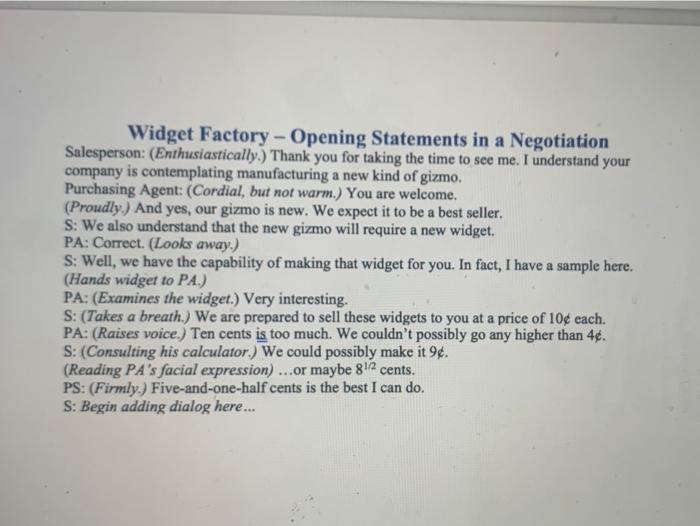
Learning Objectives and Key Terms Instructions: Review the Chapter 3 Learning Objectives and key terms below. Learning Objectives to understand the characteristics of distributive bargaining to be able to identify hardball tactics and to know how to counter them to understand the role that reference points play in negotiation. To know when you should make the first offer to understand the role of concessions to understand fairness norms Key Terms Distributive negotiations/bargaining Claiming value Single-issue negotiations Contentious or hardball tactics: highball/lowball, intimidation, bogey, nibble, chicken, and good cop/bad cop Reference points: AL, BATNA, RP, and objective information Bargaining zones and zones of potential/possible agreement Norm of reciprocity Fairness norms Instructions - continued: 1. In the dialog below, a bargaining session has just begun. Read the dialogue and decide in which direction the negotiation might go-it could be positive, negative or neutral. 2. Choose one of the key terms or learning objectives printed in bold above that might cause the negotiation to go in the direction you have chosen. 3. Write additional dialogue that shows how the negotiation might progress from the opening statements to the conclusion you chose in Step 1. 4. Add additional information if necessary, typed in italics. For instance, you could indicate what each party is thinking, specify a reservation price, a BATNA, the actual bargaining zone, etc. 5. Your objective is to show how bargaining strategies might look in a real-life situation. 6. Be creative! There is no one right answer! Widget Factory - Opening Statements in a Negotiation Salesperson: (Enthusiastically.) Thank you for taking the time to see me. I understand your company is contemplating manufacturing a new kind of gizmo. Purchasing Agent: (Cordial, but not warm.) You are welcome. (Proudly.) And yes, our gizmo is new. We expect it to be a best seller. S: We also understand that the new gizmo will require a new widget. PA: Correct. (Looks away.) S: Well, we have the capability of making that widget for you. In fact, I have a sample here. (Hands widget to PA.) PA: (Examines the widget.) Very interesting. S: (Takes a breath.) We are prepared to sell these widgets to you at a price of 10 each. PA: (Raises voice.) Ten cents is too much. We couldn't possibly go any higher than 4. S: (Consulting his calculator.) We could possibly make it 9. (Reading PA's facial expression) ...or maybe 812 cents. PS: (Firmly.) Five-and-one-half cents is the best I can do. S: Begin adding dialog here









 Study Help