







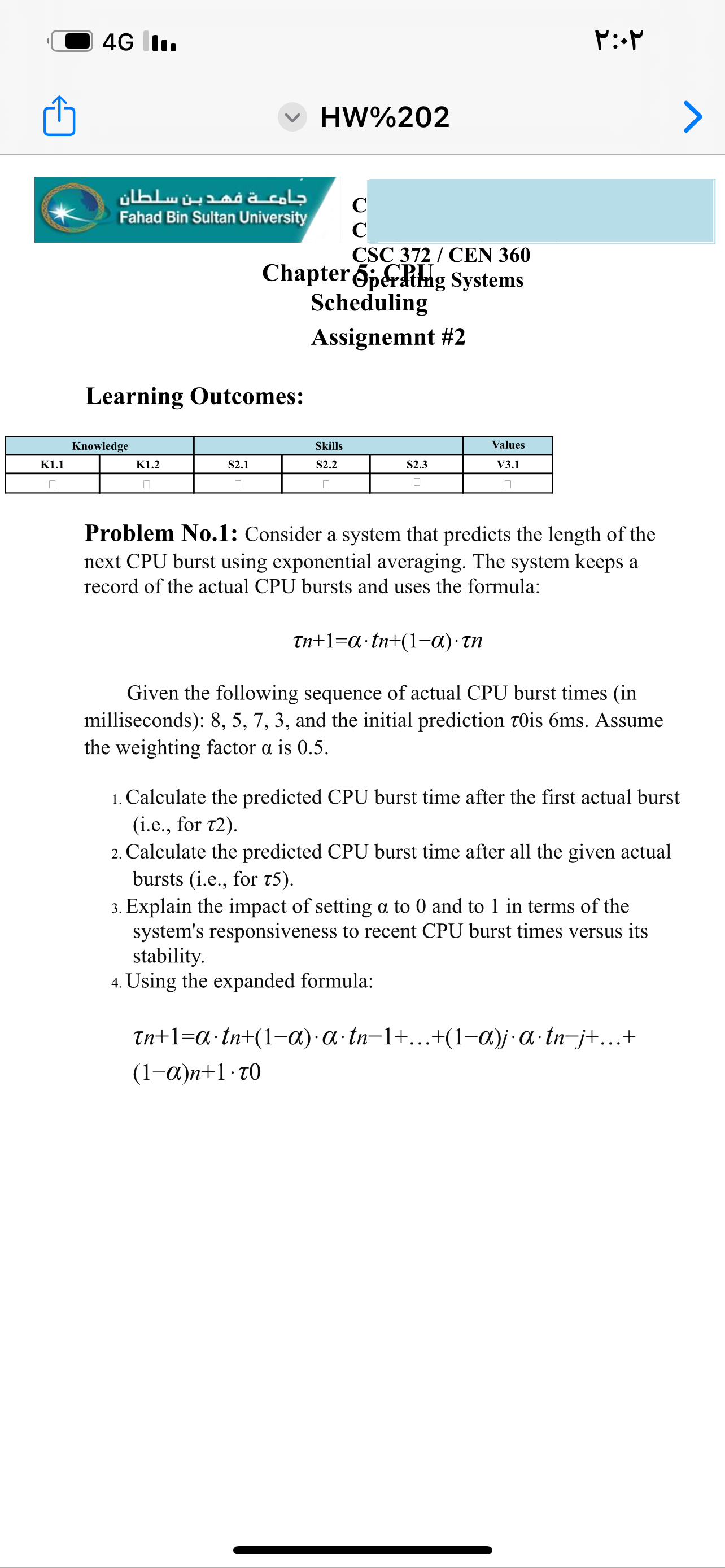
Question: Learning Outcomes: Problem No . 1 : Consider a system that predicts the length of the next CPU burst using exponential averaging. The system keeps
Learning Outcomes:
Problem No: Consider a system that predicts the length of the
next CPU burst using exponential averaging. The system keeps a
record of the actual CPU bursts and uses the formula:
Given the following sequence of actual CPU burst times in
milliseconds: and the initial prediction is Assume
the weighting factor is
Calculate the predicted CPU burst time after the first actual burst
ie for
Calculate the predicted CPU burst time after all the given actual
bursts ie for
Explain the impact of setting to and to in terms of the
system's responsiveness to recent CPU burst times versus its
stability.
Using the expanded formula:
dotsdots
Step by Step Solution
There are 3 Steps involved in it
1 Expert Approved Answer
Step: 1 Unlock

Question Has Been Solved by an Expert!
Get step-by-step solutions from verified subject matter experts
Step: 2 Unlock
Step: 3 Unlock
 Study Help