Question: leg n = q'+p Example: f = 3 f = 3 h = 5 h = 5 g = 4 h2 = $2 + 2
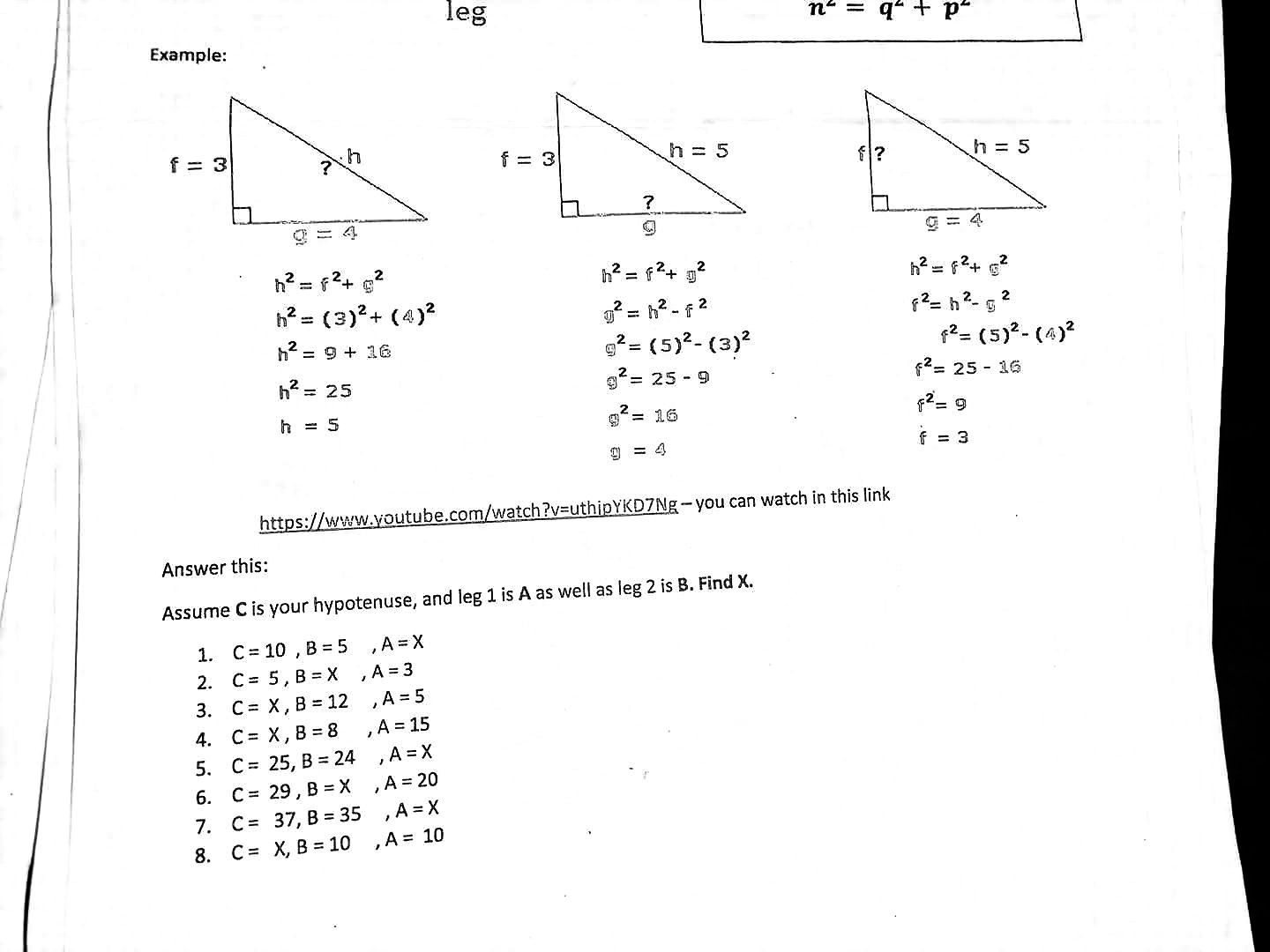
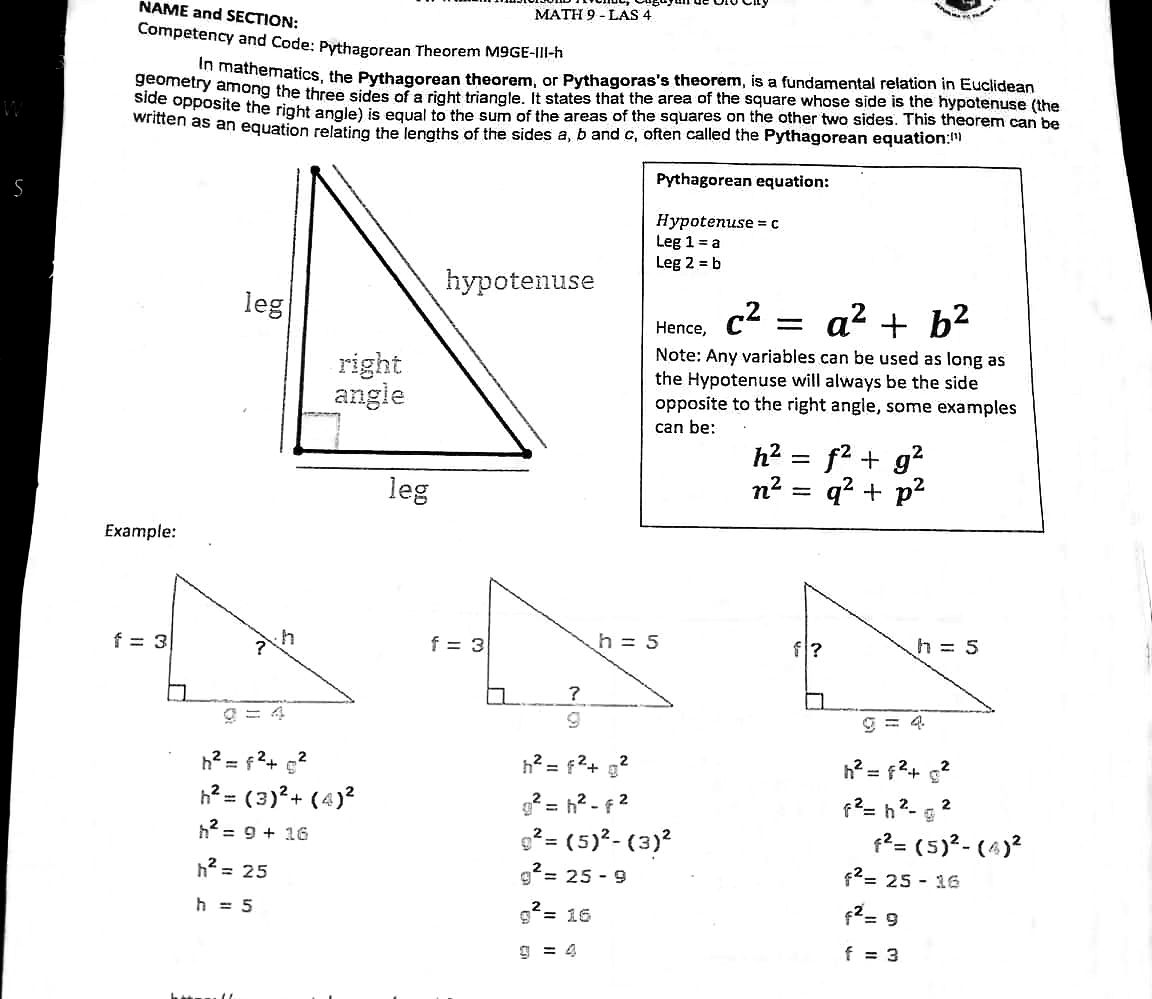
leg n = q'+p Example: f = 3 f = 3 h = 5 h = 5 g = 4 h2 = $2 + 2 h2 = f2 + 2 h2 = $2+ 62 h2 = (3)2 + (4 )2 12 = 12 - $2 $ 2 = h 2- 2 h2 = 9 + 16 42= (5)2- (3)2 $2 = (5) 2 - (4) 2 h= = 25 9 = 25 - 9 $2= 25 - 16 h = 5 9= 16 F2 = 9 g =4 f = 3 https://www.youtube.com/watch?v=uthipYKD7Ng - you can watch in this link Answer this: Assume C is your hypotenuse, and leg 1 is A as well as leg 2 is B. Find X. 1. C = 10 , B=5 , A=X 2. C = 5, B=X , A=3 3. C = X, B = 12 , A=5 4. C= X, B = 8 , A = 15 5. C= 25, B = 24 , A =X 6. C= 29 , B = X , A= 20 7. C= 37, B = 35 , A =X 8. C= X, B = 10 , A = 10NAME and SECTION: MATH 9 - LAS 4 Competency and Code: Pythagorean Theorem M9GE-III-h In mathematics, the Pythagorean theorem, or Pythagoras's theorem, is a fundamental relation in Euclidean geometry among the three sides of a right triangle. It states that the area of the square whose side is the hypotenuse (the side opposite the right angle) is equal to the sum of the areas of the squares on the other two sides. This theorem can be written as an equation relating the lengths of the sides a, b and c, often called the Pythagorean equation:!') Pythagorean equation: Hypotenuse = c Leg 1 = a Leg 2 = b hypotenuse leg Hence , c2 = a2+ 62 right Note: Any variables can be used as long as the Hypotenuse will always be the side angle opposite to the right angle, some examples can be: h2 = f2+ g2 leg n2 = q2 + p2 Example: f = 3 2 ch f = 3 h = 5 fi? h = 5 L g = 4 g = 4 h 2 = $2 + 2 h = = $2 + 2 h2 = $2+ 2 h2 = (3)2 + (4)2 02 = 12 - $ 2 f 2 = h 2- 2 h2 = 9+ 16 92 = (5)2- (3)2 $2 = (5) 2 - (1) 2 h
Step by Step Solution
There are 3 Steps involved in it
1 Expert Approved Answer
Step: 1 Unlock
Question Has Been Solved by an Expert!
Get step-by-step solutions from verified subject matter experts
Step: 2 Unlock
Step: 3 Unlock
Students Have Also Explored These Related Mathematics Questions!









 Study Help