







Question: Lemansky Enterprises is considering a change from its current capital structure. The company currently has an all - equity capital structure and is considering a
Lemansky Enterprises is considering a change from its current capital structure. The company currently has an allequity capital
structure and is considering a capital structure with percent debt. There are currently shares outstanding at a price per share
of $ EBIT is expected to remain constant at $ The interest rate on new debt is percent and there are no taxes.
a Rebecca owns $ worth of stock in the company. If the firm has a percent payout, what is her cash flow?
Note: Do not round intermediate calculations and round your answer to decimal places,
b What would her cash flow be under the new capital structure assuming that she keeps all of her shares?
Note: Do not round intermediate calculations and round your answer to decimal places,
c Suppose the company does convert to the new capital structure. Show how Rebecca can maintain her current cash flow.
Note: Do not round intermediate calculations and round your answer to the nearest whole number,
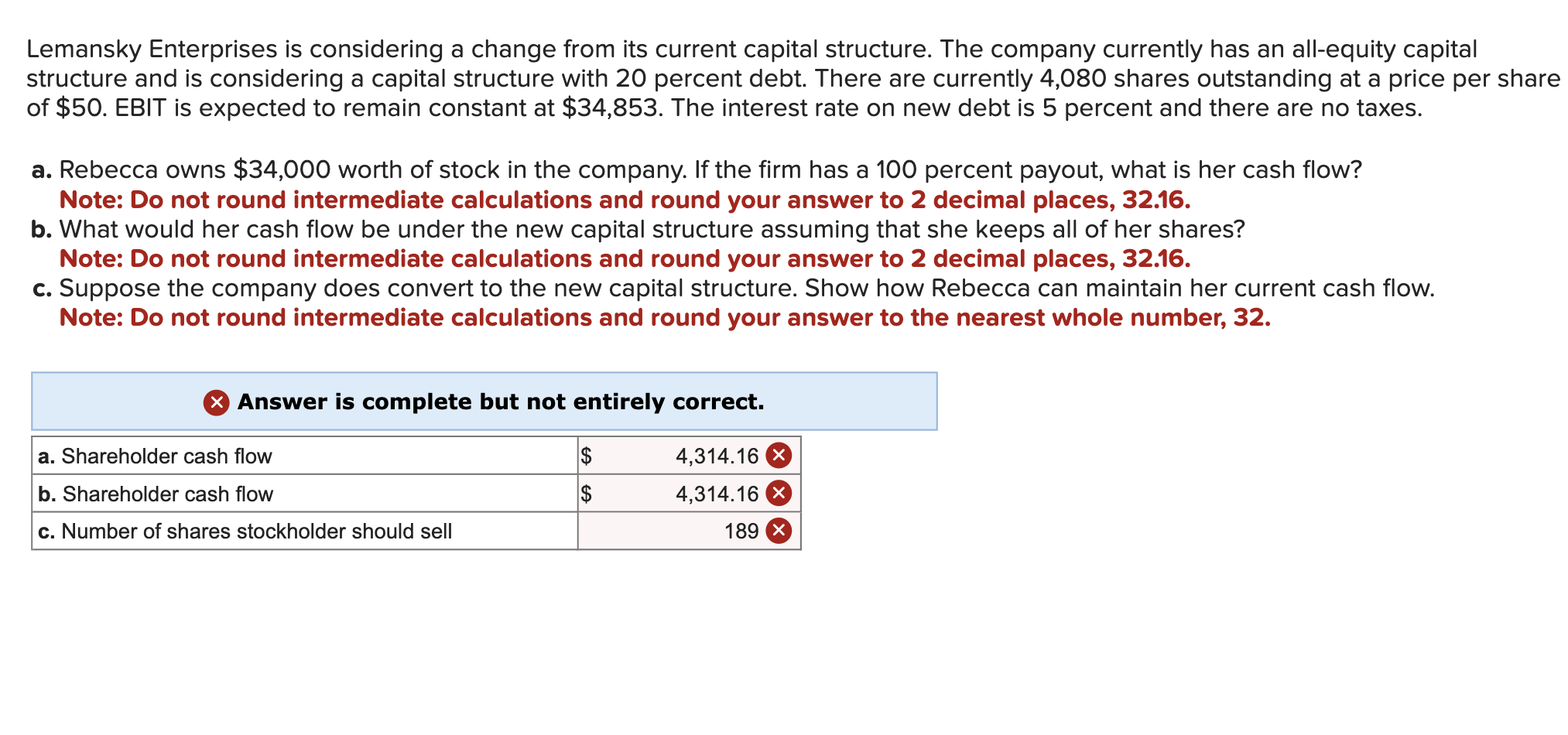
Answer is complete but not entirely correct. Lemansky Enterprises is considering a change from its current capital structure. The company currently has an allequity capital
structure and is considering a capital structure with percent debt. There are currently shares outstanding at a price per share
of $ EBIT is expected to remain constant at $ The interest rate on new debt is percent and there are no taxes.
a Rebecca owns $ worth of stock in the company. If the firm has a percent payout, what is her cash flow?
Note: Do not round intermediate calculations and round your answer to decimal places,
b What would her cash flow be under the new capital structure assuming that she keeps all of her shares?
Note: Do not round intermediate calculations and round your answer to decimal places,
c Suppose the company does convert to the new capital structure. Show how Rebecca can maintain her current cash flow.
Note: Do not round intermediate calculations and round your answer to the nearest whole number,
a Shareholder cash flow
b Shareholder cash flow
c Number of shares stockholder should sell
Step by Step Solution
There are 3 Steps involved in it
1 Expert Approved Answer
Step: 1 Unlock

Question Has Been Solved by an Expert!
Get step-by-step solutions from verified subject matter experts
Step: 2 Unlock
Step: 3 Unlock
 Study Help