





Question: Lesson 11 Practice Problems 4. Here is a graph of sequence r. Define r recursively using 20 1 . Find the sum of the sequence
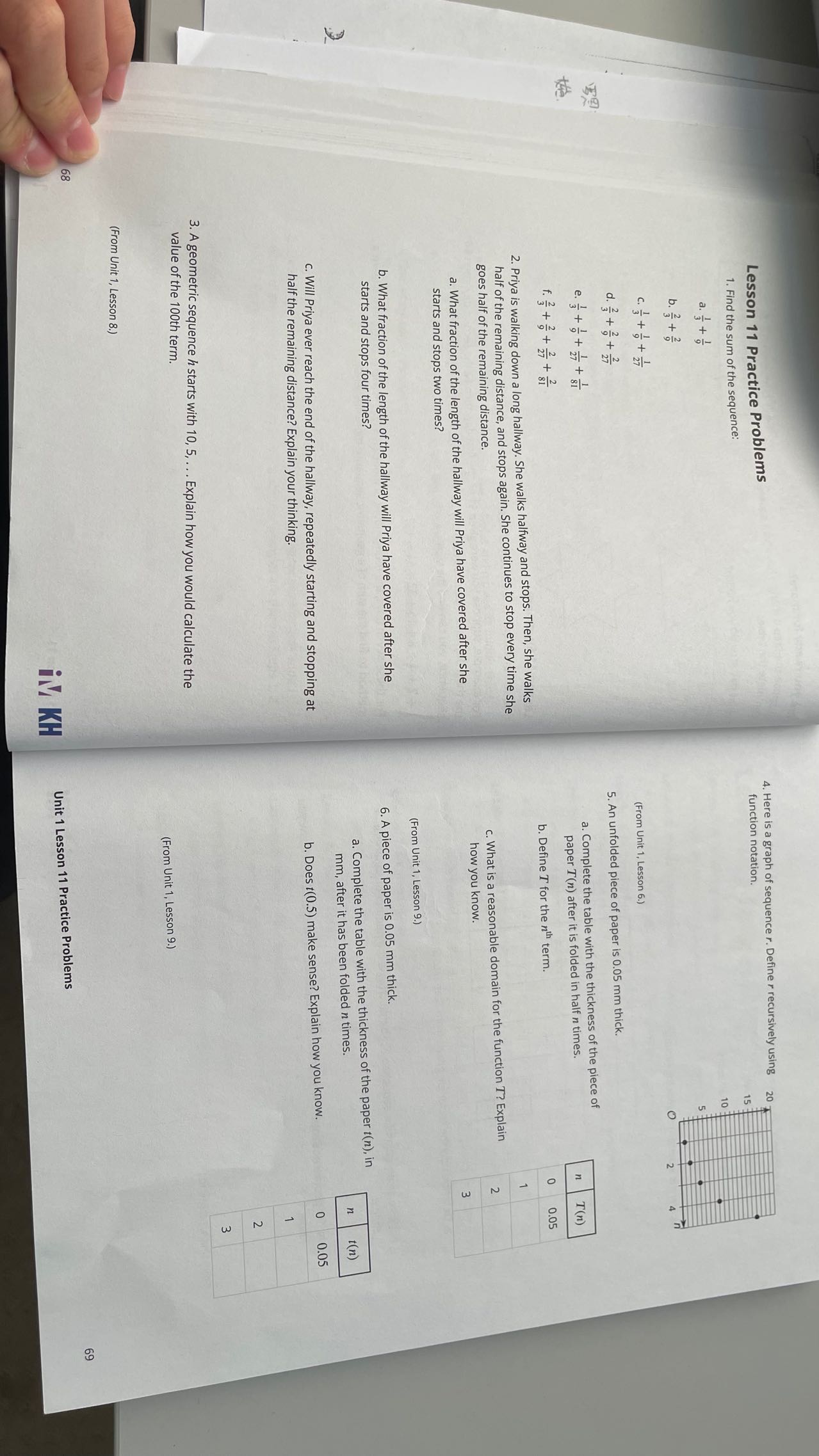
Lesson 11 Practice Problems 4. Here is a graph ofLesson 11 Practice Problems 4. Here is a graph of
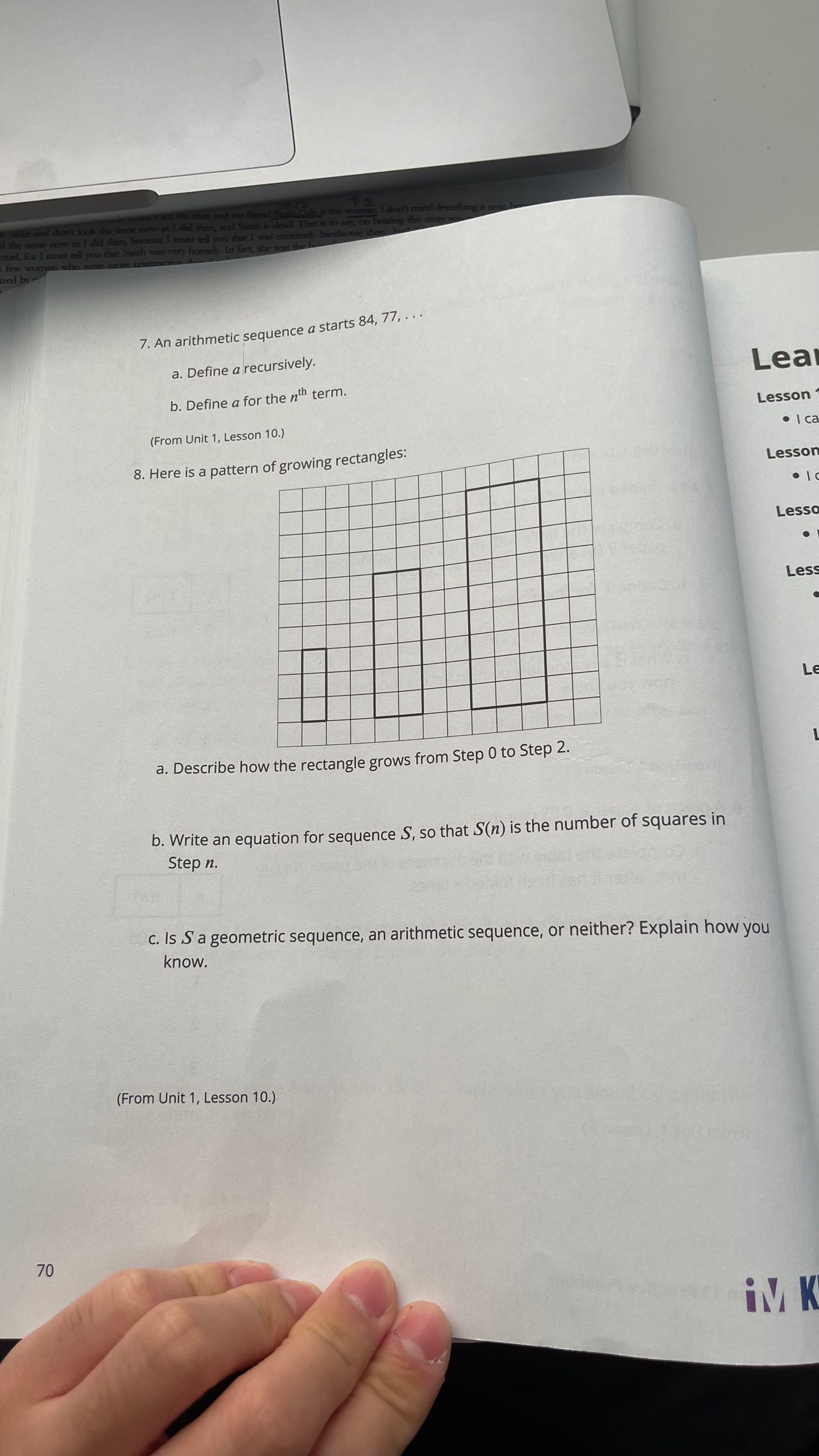
Lesson 11 Practice Problems 4. Here is a graph of sequence r. Define r recursively using 20 1 . Find the sum of the sequence : function notation. a. 3 + 2 b. 2+ - C. "+ + 27 (From Unit 1, Lesson 6.) d. 2 + + 27 5. An unfolded piece of paper is 0.05 mm thick. e. 7 + 5 + 27 + 31 a. Complete the table with the thickness of the piece of f. 2 + 2 + 7 + 31 paper T(n) after it is folded in half n times. T(n) b. Define T for the nith term. 0.05 2. Priya is walking down a long hallway. She walks halfway and stops. Then, she walks half of the remaining distance, and stops again. She continues to stop every time she goes half of the remaining distance. C. What is a reasonable domain for the function T? Explain N a. What fraction of the length of the hallway will Priya have covered after she how you know . starts and stops two times? m (From Unit 1, Lesson 9.) b. What fraction of the length of the hallway will Priya have covered after she starts and stops four times? 6. A piece of paper is 0.05 mm thick. a. Complete the table with the thickness of the paper t(n), in mm, after it has been folded n times. S t(n) C. Will Priya ever reach the end of the hallway, repeatedly starting and stopping at half the remaining distance? Explain your thinking. b. Does t(0.5) make sense? Explain how you know. 0.05 V m 3. A geometric sequence h starts with 10, 5, . . . Explain how you would calculate the value of the 100th term. ( From Unit 1, Lesson 9.) (From Unit 1, Lesson 8.) iM KH Unit 1 Lesson 11 Practice Problems7. An arithmetic sequence a starts 84, 77, ... a. Define a recursively. Lea b. Define a for the nith term. Lesson (From Unit 1, Lesson 10.) . I ca 8. Here is a pattern of growing rectangles: Lesson Less Less LE a. Describe how the rectangle grows from Step 0 to Step 2. b. Write an equation for sequence S, so that S(n) is the number of squares in Step n. c. Is S a geometric sequence, an arithmetic sequence, or neither? Explain how you know. (From Unit 1, Lesson 10.) 70 iM K

Step by Step Solution

There are 3 Steps involved in it

1 Expert Approved Answer
Step: 1 Unlock blur-text-image
Question Has Been Solved by an Expert!

Get step-by-step solutions from verified subject matter experts

Step: 2 Unlock
Step: 3 Unlock

Students Have Also Explored These Related Mathematics Questions!