





Question: Lesson 3-Chapter 6 1. The chapter starts with a discussion of Adapting Style to the Reader. What does this mean, how is it accomplished, and
Lesson 3-Chapter 6 1. The chapter starts with a
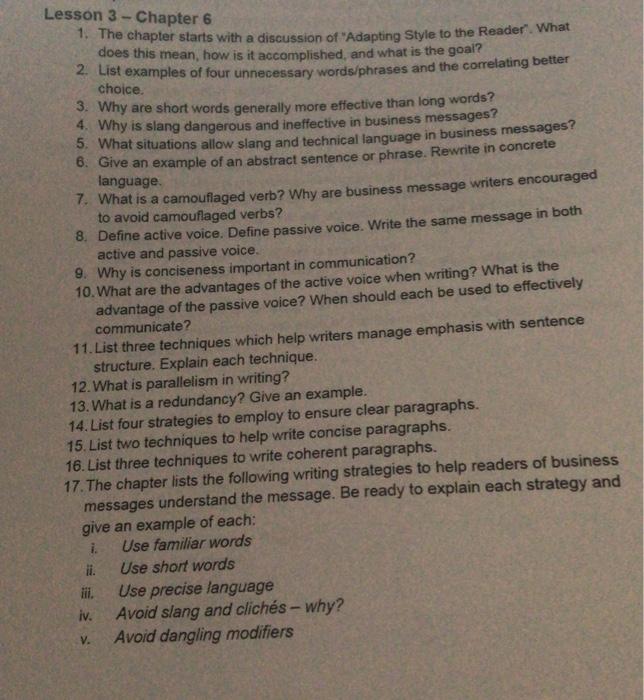
Lesson 3-Chapter 6 1. The chapter starts with a discussion of "Adapting Style to the Reader". What does this mean, how is it accomplished, and what is the goal? 2. List examples of four unnecessary words/phrases and the correlating better choice. 3. Why are short words generally more effective than long words? 4. Why is slang dangerous and ineffective in business messages? 5. What situations allow slang and technical language in business messages? 6. Give an example of an abstract sentence or phrase. Rewrite in concrete language. 7. What is a camouflaged verb? Why are business message writers encouraged to avoid camouflaged verbs? 8. Define active voice. Define passive voice. Write the same message in both active and passive voice. 9. Why is conciseness important in communication? 10. What are the advantages of the active voice when writing? What is the advantage of the passive voice? When should each be used to effectively communicate? 11. List three techniques which help writers manage emphasis with sentence structure. Explain each technique. 12. What is parallelism in writing? 13. What is a redundancy? Give an example. 14. List four strategies to employ to ensure clear paragraphs. 15. List two techniques to help write concise paragraphs. 16. List three techniques to write coherent paragraphs. 17. The chapter lists the following writing strategies to help readers of business messages understand the message. Be ready to explain each strategy and give an example of each: i. Use familiar words ii. Use short words iii. Use precise language iv. Avoid slang and clichs - why? v. Avoid dangling modifiers

Step by Step Solution

There are 3 Steps involved in it

1 Expert Approved Answer
Step: 1 Unlock blur-text-image

Question Has Been Solved by an Expert!

Get step-by-step solutions from verified subject matter experts

Step: 2 Unlock
Step: 3 Unlock

Students Have Also Explored These Related General Management Questions!