



Question: Lesson 9 covered long-term operating assets. In this case study, you will review the two annual reports and test your knowledge of long-term operating assets.

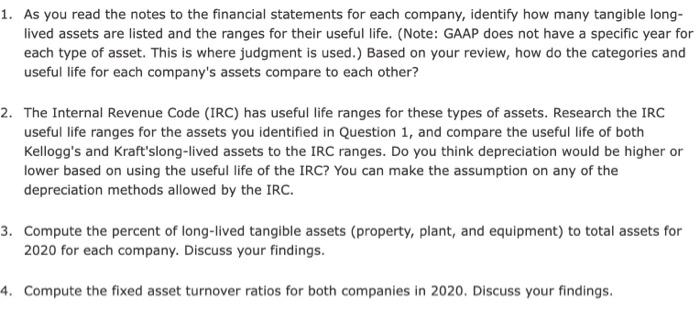
Lesson 9 covered long-term operating assets. In this case study, you will review the two annual reports and test your knowledge of long-term operating assets. 1. Access the annual reports for Kellogg.Company_(2020) and The Kraft Heinz Company_(2020). 2. In a Word document, answer the questions in the box below. Be sure to label each question with the appropriate number. As you read the notes to the financial statements for each company, identify how many tangible longlived assets are listed and the ranges for their useful life. (Note: GAAP does not have a specific year for each type of asset. This is where judgment is used.) Based on your review, how do the categories and useful life for each company's assets compare to each other? The Internal Revenue Code (IRC) has useful life ranges for these types of assets. Research the IRC useful life ranges for the assets you identified in Question 1 , and compare the useful life of both Kellogg's and Kraft'slong-lived assets to the IRC ranges. Do you think depreciation would be higher or lower based on using the useful life of the IRC? You can make the assumption on any of the depreciation methods allowed by the IRC. Compute the percent of long-lived tangible assets (property, plant, and equipment) to total assets for 2020 for each company. Discuss your findings. Compute the fixed asset turnover ratios for both companies in 2020. Discuss your findings
Step by Step Solution
There are 3 Steps involved in it

Get step-by-step solutions from verified subject matter experts