







Question: Let A = {1, 3, 5, 7, 9}, B = {2, 4, 6, 7, 9}, C = {x Z - 5 x 5}, D
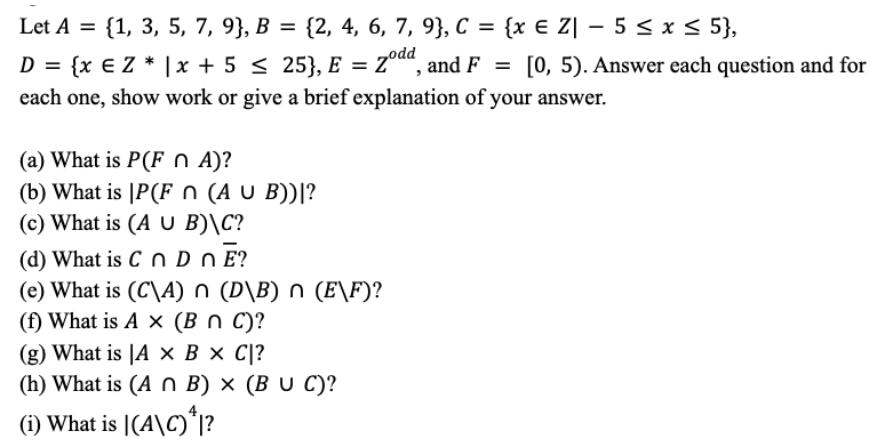
Let A = {1, 3, 5, 7, 9}, B = {2, 4, 6, 7, 9}, C = {x Z - 5 x 5}, D | z = = {x Z * x + 5 25}, E = Zodd, and F = [0, 5). Answer each question and for each one, show work or give a brief explanation of your answer. (a) What is P(F n A)? (b) What is IP(F n (A U B))|? (c) What is (A U B)\C? (d) What is C n D n E? (e) What is (C\A) n (D\B) n (E\F)? (f) What is A x (B n C)? (g) What is A x B x C|? (h) What is (An B) x (B U C)? (i) What is |(A\C)*|?
Step by Step Solution
3.47 Rating (167 Votes )
There are 3 Steps involved in it
a What is PFn A ANSWER PFn A PF PA 12 12 14 EXPLANATION This is because the probability of F and A are both 12 so the probability of their intersection is 14 b What is PFn A U B ANSWER PFn A U B PF PA ... View full answer

Get step-by-step solutions from verified subject matter experts
 Study Help