







Question: Let a = (1,2, 1), c = (3, 1, -5) and d = (3, 1, 5). (a) Without trying to write out the components
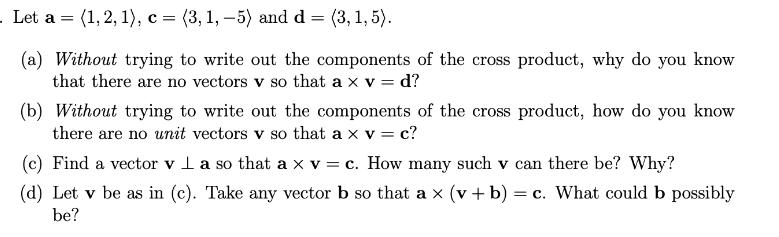
Let a = (1,2, 1), c = (3, 1, -5) and d = (3, 1, 5). (a) Without trying to write out the components of the cross product, why do you know that there are no vectors v so that a x v = d? (b) Without trying to write out the components of the cross product, how do you know there are no unit vectors v so that a x v = c? (c) Find a vector v 1a so that a x v = c. How many such v can there be? Why? (d) Let v be as in (c). Take any vector b so that a x (v + b) = c. What could b possibly be?
Step by Step Solution
3.40 Rating (147 Votes )
There are 3 Steps involved in it
Lets address each part of the question step by step a Without writing out the components of the cross product you need to determine why there are no v... View full answer

Get step-by-step solutions from verified subject matter experts
 Study Help