







Question: Let A and B be two stations to transmit on an Ethernet 3) Let A and B be two stations attempting to transmit on an
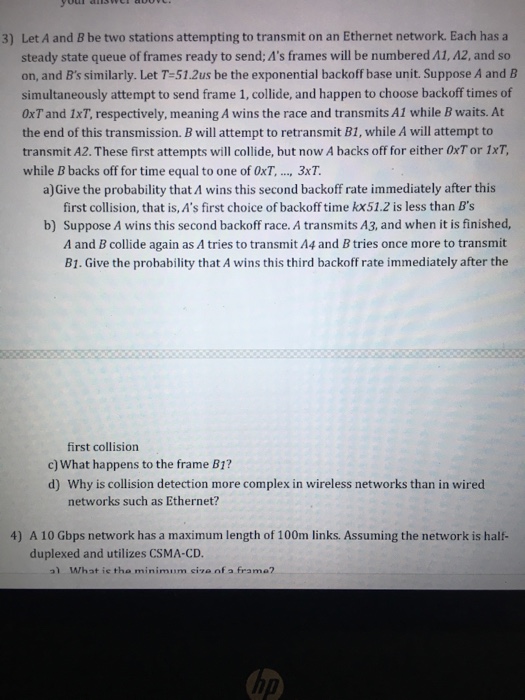
3) Let A and B be two stations attempting to transmit on an Ethernet network. Each has a steady state queue of frames ready to send:A's frames will be numbered 1,A2, and so on, and B's similarly. Let T-51.2us be the exponential backoff base unit. Suppose A and B simultaneously attempt to send frame 1, collide, and happen to choose backoff times of OxT and 1xT, respectively, meaning A wins the race and transmits A1 while B waits. At the end of this transmission. B will attempt to retransmit B1, while A will attempt to transmit A2. These first attempts will collide, but now A backs off for either OxT or 1xT, while B backs off for time equal to one of OxT,.., 3xT. a) Give the probability that wins this second backoff rate immediately after this first collision, that is, A's first choice of backoff time kx51.2 is less than B's b) Suppose A wins this second backoff race. A transmits A3, and when it is finished, A and B collide again as A tries to transmit A4 and B tries once more to transmit B1. Give the probability that A wins this third backoff rate immediately after the first collision c) What happens to the frame B1? d) Why is collision detection more complex in wireless networks than in wired networks such as Ethernet? 4) A 10 Gbps network has a maximum length of 100m links. Assuming the network is half- duplexed and utilizes CSMA-CD. al WWhatic the minimum size ofa frame
Step by Step Solution
There are 3 Steps involved in it

Get step-by-step solutions from verified subject matter experts
 Study Help