







Question: Let = {a, b, c, d} and consider the nondeterministic state diagram with transitions given in Figure 2. Using the systematic method described in the
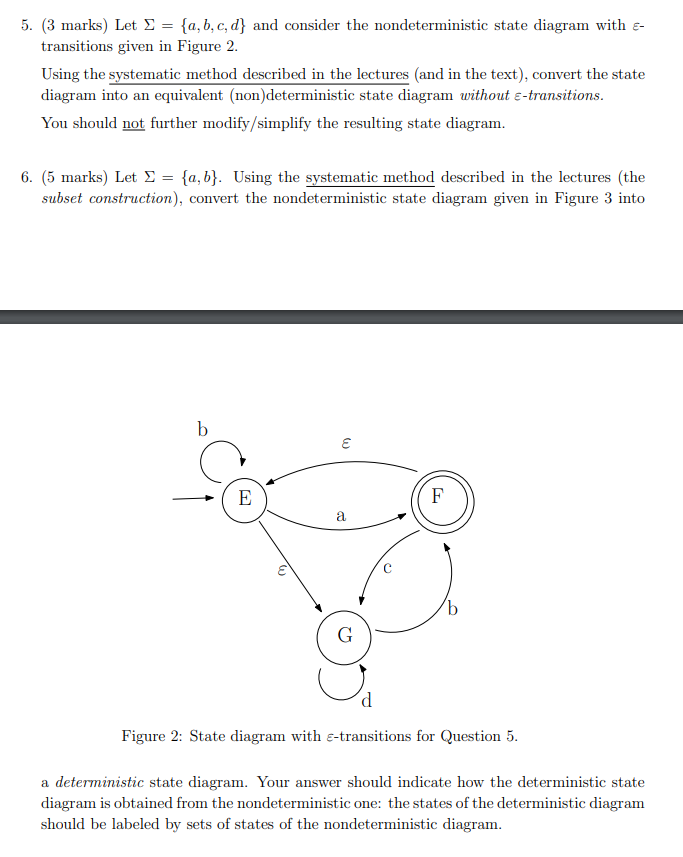 Let = {a, b, c, d} and consider the nondeterministic state diagram with transitions given in Figure 2. Using the systematic method described in the lectures (and in the text), convert the state diagram into an equivalent (non)deterministic state diagram without -transitions. You should not further modify/simplify the resulting state diagram. 6. (5 marks) Let = {a, b}. Using the systematic method described in the lectures (the subset construction), convert the nondeterministic state diagram given in Figure 3 into E F G b a b c d Figure 2: State diagram with -transitions for Question 5. a deterministic state diagram. Your answer should indicate how the deterministic state diagram is obtained from the nondeterministic one: the states of the deterministic diagram should be labeled by sets of states of the nondeterministic diagram.
= 5. (3 marks) Let S = {a,b,c,d} and consider the nondeterministic state diagram with s- transitions given in Figure 2. Using the systematic method described in the lectures and in the text), convert the state diagram into an equivalent (non deterministic state diagram without e-transitions. You should not further modify/simplify the resulting state diagram. 6. (5 marks) Let S = {a,b}. Using the systematic method described in the lectures (the subset construction), convert the nondeterministic state diagram given in Figure 3 into b E E F a b G G Figure 2: State diagram with e-transitions for Question 5. a deterministic state diagram. Your answer should indicate how the deterministic state diagram is obtained from the nondeterministic one: the states of the deterministic diagram should be labeled by sets of states of the nondeterministic diagram
Step by Step Solution
There are 3 Steps involved in it

Get step-by-step solutions from verified subject matter experts
 Study Help