







Question: Let ? = {a, b, c, d, e}. Consider three r.v.: a) r.v. X : X(a) = 1, X(b) = 1, X(c) = 1, X(d)
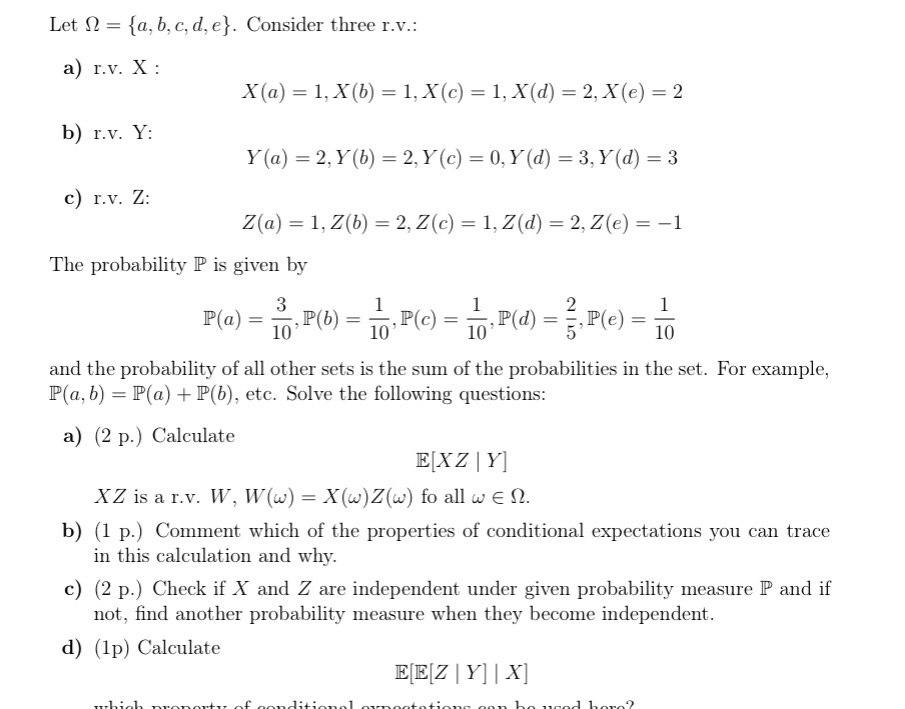
Let ? = {a, b, c, d, e}. Consider three r.v.: a) r.v. X : X(a) = 1, X(b) = 1, X(c) = 1, X(d) = 2, X(e) = 2 b) r.v. Y: Y(a) = 2, Y(b) = 2, Y(c) = 0, Y(d) = 3, Y(d) = 3 c) r.v. Z: Z(a) = 1, Z(b) = 2, Z(c) = 1, Z(d) = 2, Z(e) = -1 The probability P is given by 3 P(a) = TO , P(b) = 10 , P(c) = 10 , P(d) = =,P(e) = and the probability of all other sets is the sum of the probabilities in the set. For example, P(a, b) = P(a) + P(b), etc. Solve the following questions: a) (2 p.) Calculate EXZ Y] XZ is a r.v. W, W(w) = X(w) Z(w) fo all wen. b) (1 p.) Comment which of the properties of conditional expectations you can trace in this calculation and why. c) (2 p.) Check if X and Z are independent under given probability measure P and if not, find another probability measure when they become independent. d) (1p) Calculate EEZY] [ X]
Step by Step Solution
There are 3 Steps involved in it

Get step-by-step solutions from verified subject matter experts
 Study Help