







Question: Let a, a2,... , ak ER, let b,b, ..., bk E Rm, and let C, C, ..., Ck E Rn+m [B] bi C =
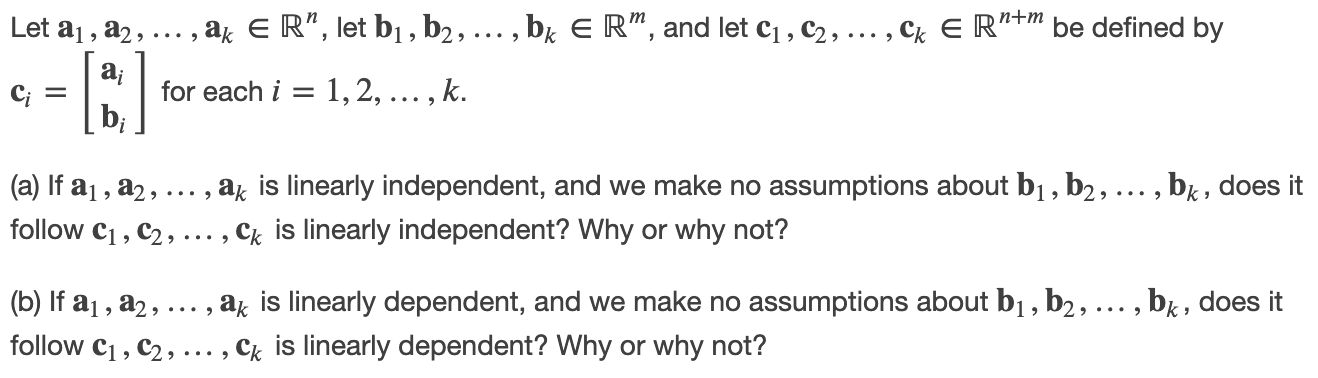
Let a, a2,... , ak ER", let b,b, ..., bk E Rm, and let C, C, ..., Ck E Rn+m [B] bi C = for each i = 1, 2, ..., k. (a) If a, a2, follow C, C2, (b) If a, a, follow C1, C, be defined by ak is linearly independent, and we make no assumptions about b,b, ..., bk, does it ,Ck is linearly independent? Why or why not? ak is linearly dependent, and we make no assumptions about b,b2, ..., bk, does it Ck is linearly dependent? Why or why not?
Step by Step Solution
3.36 Rating (140 Votes )
There are 3 Steps involved in it
To solve the problem lets analyze each part separately Part a Statement If mathbfa1 mathbfa2 ldots mathbfak is linearly independent and we make no ass... View full answer

Get step-by-step solutions from verified subject matter experts
 Study Help