







Question: Let A(2, 5), B(11, -4), C(7, 10) be points in R2. We say that an affine transformation T of R2 is a diagonal transformation if
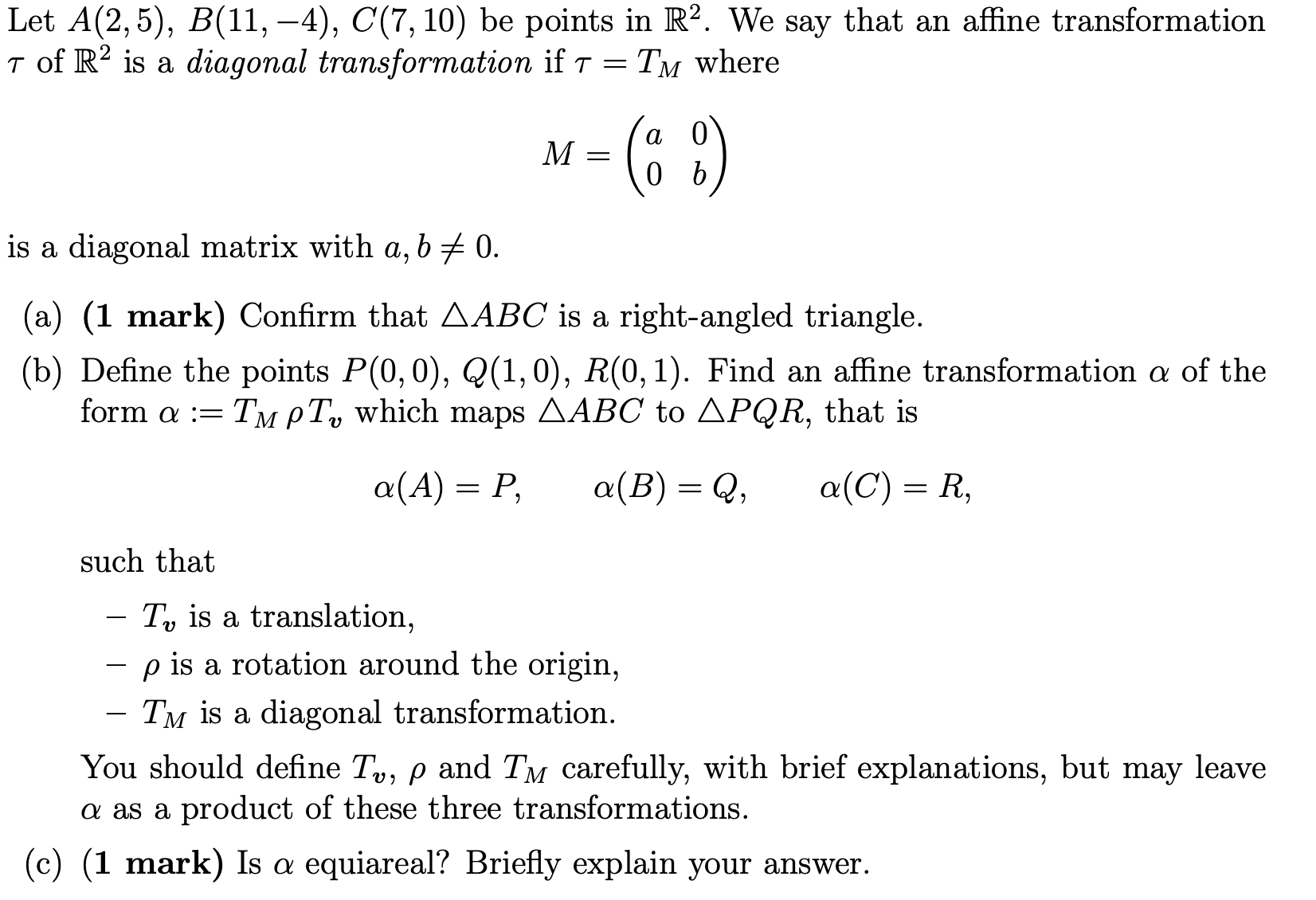
Let A(2, 5), B(11, -4), C(7, 10) be points in R2. We say that an affine transformation T of R2 is a diagonal transformation if T = TM where a M = 0 O is a diagonal matrix with a, b * 0. (a) (1 mark) Confirm that AABC is a right-angled triangle. (b) Define the points P(0, 0), Q(1, 0), R(0, 1). Find an affine transformation a of the form a := TM pT, which maps AABC to APQR, that is a (A) = P, a ( B ) = Q , a ( C ) = R , such that - To is a translation, - p is a rotation around the origin, - TM is a diagonal transformation. You should define Tv, p and TM carefully, with brief explanations, but may leave a as a product of these three transformations. (c) (1 mark) Is a equiareal? Briefly explain your
Step by Step Solution
There are 3 Steps involved in it

Get step-by-step solutions from verified subject matter experts
 Study Help