





Question: Let Bk = { l, . .. , k} be the standard k-element set. Ftecall that the matrix MU) associated to a map f :
Let Bk = { l, . .. , k} be the standard k-element
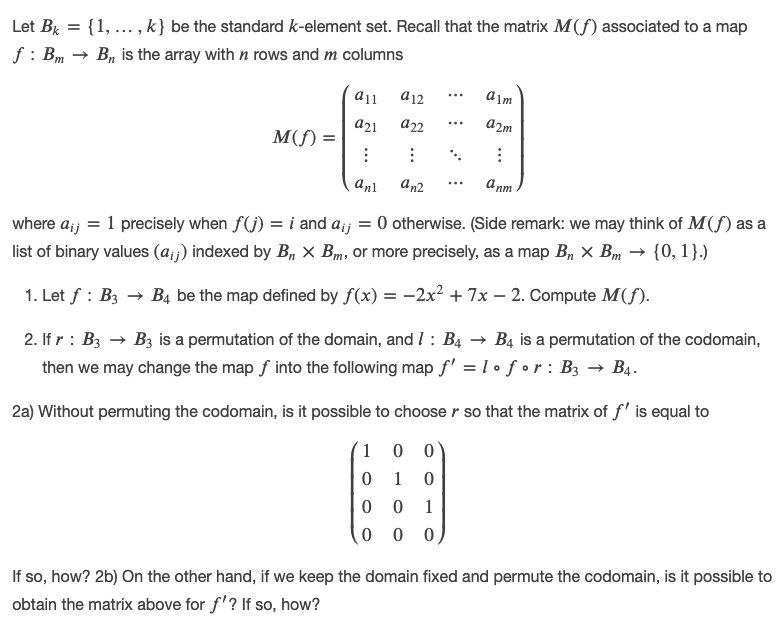
Let Bk = { l, . .. , k} be the standard k-element set. Ftecall that the matrix MU") associated to a map f : Em > B\" is the arrayr with a rows and m columns a\" IE112 \"1m IE321 H22 \"2: M(f} = 1Jill 1.12 '" llamt-1 where a\" = 1 preciser when fi) = r' and fj = [1 otherwise. (Side remark: we may think of MU\") as a list of binary values {cu} indexed by B\" x 3,", or more precisely, as a map E" x Em > {[1, 1}.) 1. Let f : B; > B4 be the map dened by f(x} = 2;ir.2 + T3: 2. Compute M(f}. 2. It r : 33 ) .33 is a permutation of the domain. and I : B4 > R; is a permutation of the codomain, then we may change the map f into the following map f' = I o f n r : B3 :r B4. EaJ Without permuting the codomain, is it possible to choose r so that the matrix of f' is equal to 1 D 1 D i] {ll 1 i] {i D It so, how? 2b] (in the other hand, if we keep the domain fixed and permute the codomain, is it possible to obtain the matrix above for f\"? If so, how

Step by Step Solution

There are 3 Steps involved in it

1 Expert Approved Answer
Step: 1 Unlock blur-text-image
Question Has Been Solved by an Expert!

Get step-by-step solutions from verified subject matter experts

Step: 2 Unlock
Step: 3 Unlock

Students Have Also Explored These Related Mathematics Questions!