







Question: Let C1 be the square oriented counterclockwise of vertices (0, 0), (0, 4), (4, 4), (4, 0) and let C2 be the triangle oriented counter
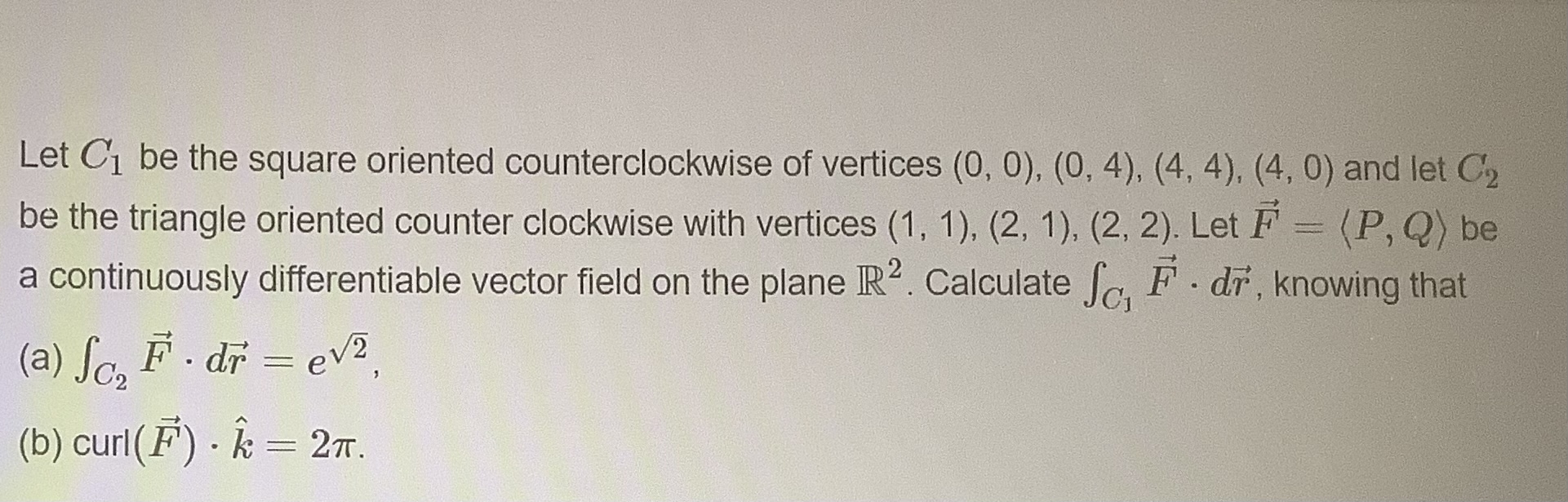
Let C1 be the square oriented counterclockwise of vertices (0, 0), (0, 4), (4, 4), (4, 0) and let C2 be the triangle oriented counter clockwise with vertices (1, 1), (2, 1), (2, 2). Let F = (P, Q) be a continuously differentiable vector field on the plane R. Calculate , F . dr, knowing that (a) So, F . dr = ev2 (b) curl ( F) . k = 27
Step by Step Solution
There are 3 Steps involved in it
1 Expert Approved Answer
Step: 1 Unlock

Question Has Been Solved by an Expert!
Get step-by-step solutions from verified subject matter experts
Step: 2 Unlock
Step: 3 Unlock
 Study Help