







Question: = Let :D CR2 (D) = S be a parametrization of a surface S; in coordinates, we express as usual (u, v) = (x(u, v),
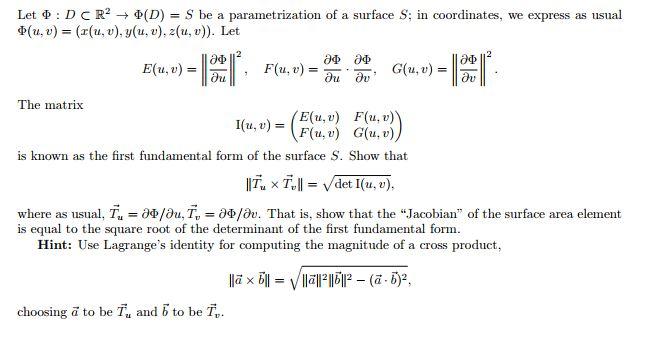
= Let :D CR2 (D) = S be a parametrization of a surface S; in coordinates, we express as usual (u, v) = (x(u, v), y(u, v), 2(u, v)). Let E(u, v) = - SF(u, v) = au au G(u, v) = |S The matrix I(u, v) = E(u, v) F(u, v) F(u, v) G(u, v)) is known as the first fundamental form of the surface S. Show that 17. T.|| = det I(u, v), where as usual, T, = 20/du, T, = 29/0u. That is show that the Jacobian" of the surface area element is equal to the square root of the determinant of the first fundamental form. Hint: Use Lagrange's identity for computing the magnitude of a cross product, ll x || = V12102 -(-6)2. choosing a to be T, and 6 to be T. = Let :D CR2 (D) = S be a parametrization of a surface S; in coordinates, we express as usual (u, v) = (x(u, v), y(u, v), 2(u, v)). Let E(u, v) = - SF(u, v) = au au G(u, v) = |S The matrix I(u, v) = E(u, v) F(u, v) F(u, v) G(u, v)) is known as the first fundamental form of the surface S. Show that 17. T.|| = det I(u, v), where as usual, T, = 20/du, T, = 29/0u. That is show that the Jacobian" of the surface area element is equal to the square root of the determinant of the first fundamental form. Hint: Use Lagrange's identity for computing the magnitude of a cross product, ll x || = V12102 -(-6)2. choosing a to be T, and 6 to be T
Step by Step Solution
There are 3 Steps involved in it

Get step-by-step solutions from verified subject matter experts
 Study Help