







Question: Let f be a function from the set { 1 , dots, n } to itself. The pointwise representation of f is a binary string
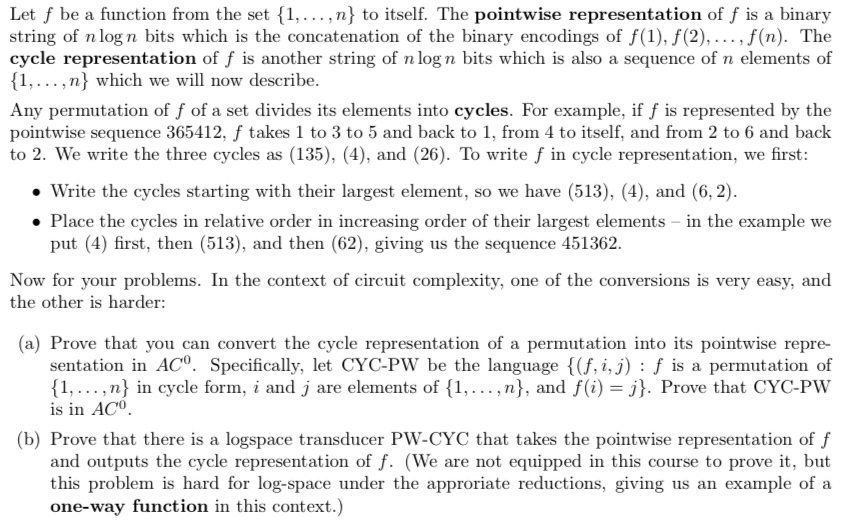
Let be a function from the set dots, to itself. The pointwise representation of is a binary string of bits which is the concatenation of the binary encodings of dots, The cycle representation of is another string of bits which is also a sequence of elements of dots, which we will now describe.
Any permutation of of a set divides its elements into cycles. For example, if is represented by the pointwise sequence takes to to and back to from to itself, and from to and back to We write the three cycles as and To write in cycle representation, we first:
Write the cycles starting with their largest element, so we have and
Place the cycles in relative order in increasing order of their largest elements in the example we put first, then and then giving us the sequence
Now for your problems. In the context of circuit complexity, one of the conversions is very easy, and the other is harder:
a Prove that you can convert the cycle representation of a permutation into its pointwise representation in Specifically, let CYCPW be the language is a permutation of dots, in cycle form, i and are elements of dots, and Prove that CYCPW is in
b Prove that there is a logspace transducer PWCYC that takes the pointwise representation of and outputs the cycle representation of We are not equipped in this course to prove it but this problem is hard for logspace under the approriate reductions, giving us an example of a oneway function in this context.
Step by Step Solution
There are 3 Steps involved in it
1 Expert Approved Answer
Step: 1 Unlock

Question Has Been Solved by an Expert!
Get step-by-step solutions from verified subject matter experts
Step: 2 Unlock
Step: 3 Unlock
 Study Help