







Question: Let f be a realvalued continuous and differentiable function. Let function g be defined by 9012) = f( '3' I 2). A student presents the
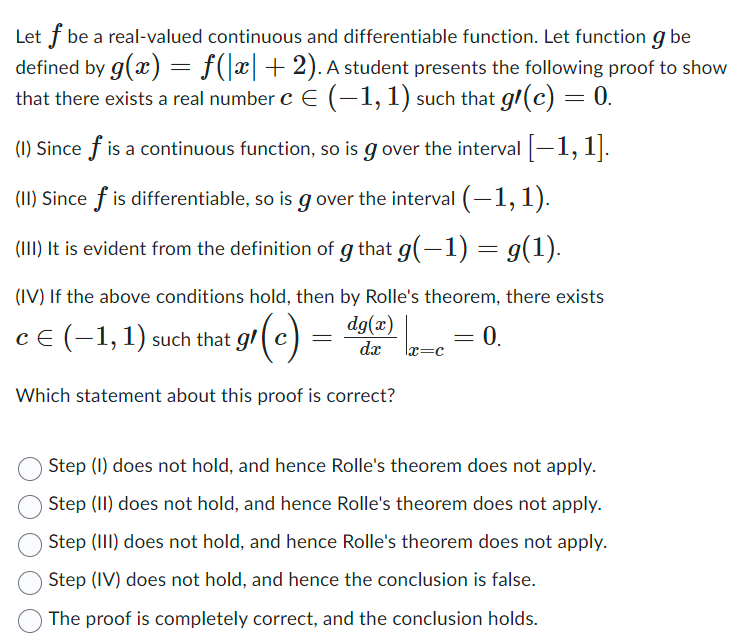
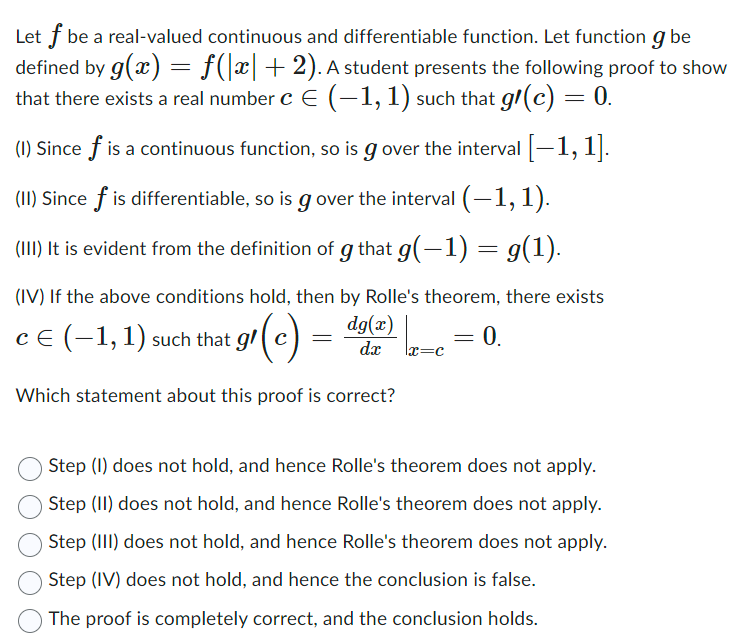
Let f be a realvalued continuous and differentiable function. Let function g be defined by 9012) = f( '3' I 2). A student presents the following proof to show that there exists a real number C E (1, 1) such that g!(e) = 0. {I} Since f is a continuous function. so is 9 over the interval [1, 1]. {II} Since f is differentiable. so is 9 over the interval (1, 1). {III} It is evident from the definition tit gthat g(1) : 9(1). {IV} If the above conditions hold, then bv Rolle's theorem. there exists C E (1, 1) such that g! (C) : dig} '13:? : 0. Which statement about this proof is correct? if). Step {I} does not hold. and hence Rolle's theorem does not applv. if). Step {II} does not hold, and hence Rolle's theorem does not applv. if). Step {III} does not hold. and hence Rolle's theorem does not applv. if} Step {IV} does not hold, and hence the conclusion is false. C] The proof is completelv correct. and the conclusion holds
Step by Step Solution
There are 3 Steps involved in it

Get step-by-step solutions from verified subject matter experts
 Study Help