







Question: Let f : Z - N be a function defined by f(x) = 1+ |x). This function is O neither injective nor bijective O injective,
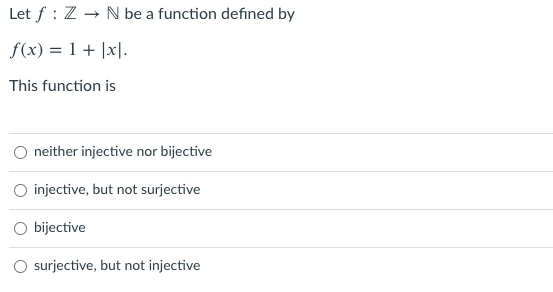
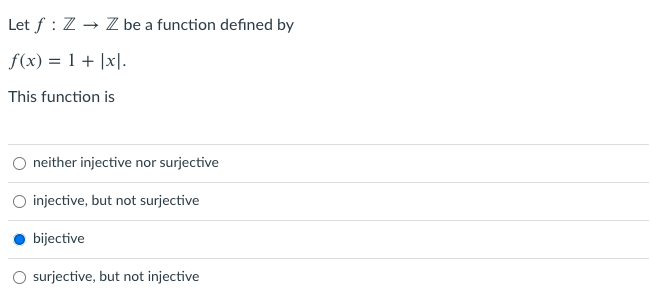
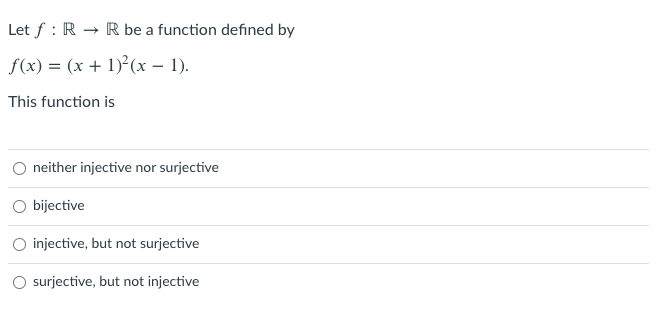
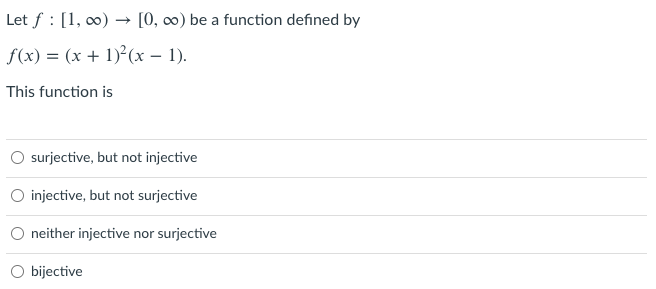
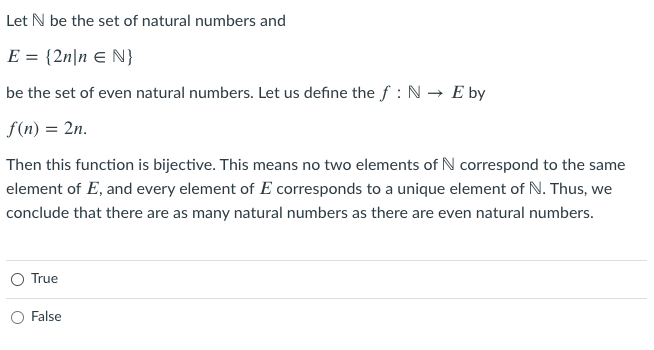
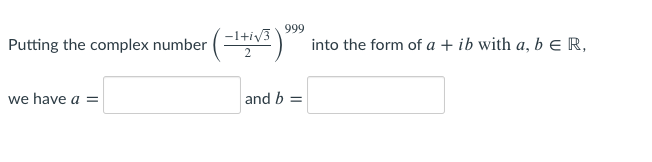
Let f : Z - N be a function defined by f(x) = 1+ |x). This function is O neither injective nor bijective O injective, but not surjective O bijective O surjective, but not injectiveLet f : Z - Z be a function defined by f (x) = 1+ Ixl. This function is neither injective nor surjective O injective, but not surjective O bijective O surjective, but not injectiveLet f : R - R be a function defined by f (x) = (x+ 1)2 (x -1). This function is O neither injective nor surjective O bijective O injective, but not surjective O surjective, but not injectiveLet f : [1, co) - [0, co) be a function defined by f (x) = (x+ 1) (x- 1). This function is O surjective, but not injective O injective, but not surjective O neither injective nor surjective O bijectiveLet N be the set of natural numbers and E = (2n|n E N) be the set of even natural numbers. Let us define the f : N - E by f(n) = 2n. Then this function is bijective. This means no two elements of N correspond to the same element of E, and every element of E corresponds to a unique element of N. Thus, we conclude that there are as many natural numbers as there are even natural numbers. O True O False999 Putting the complex number -1+iv/3 2 into the form of a + ib with a, be R, we have a = and b =
Step by Step Solution
There are 3 Steps involved in it

Get step-by-step solutions from verified subject matter experts
 Study Help