







Question: Let f(n) and g(n) be asymptotically nonnegative functions (a function is asymptotically nonnegative whenever n is sufficiently large). Show that f(n) + g(n) = 0(max(f(n),
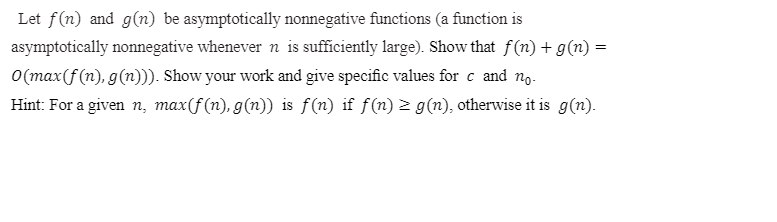
Let f(n) and g(n) be asymptotically nonnegative functions (a function is asymptotically nonnegative whenever n is sufficiently large). Show that f(n) + g(n) = 0(max(f(n), g(n))). Show your work and give specific values for c and no. Hint: For a given n, max(f(n), g(n)) is f(n) if f(n) 2 g(n), otherwise it is g(n)
Step by Step Solution
There are 3 Steps involved in it
1 Expert Approved Answer
Step: 1 Unlock

Question Has Been Solved by an Expert!
Get step-by-step solutions from verified subject matter experts
Step: 2 Unlock
Step: 3 Unlock
 Study Help