







Question: Let f(x) = _. (a) Simplify (3 + h) - f(3) h Algebraically simplify your answer until you have cancelled out the factor of h
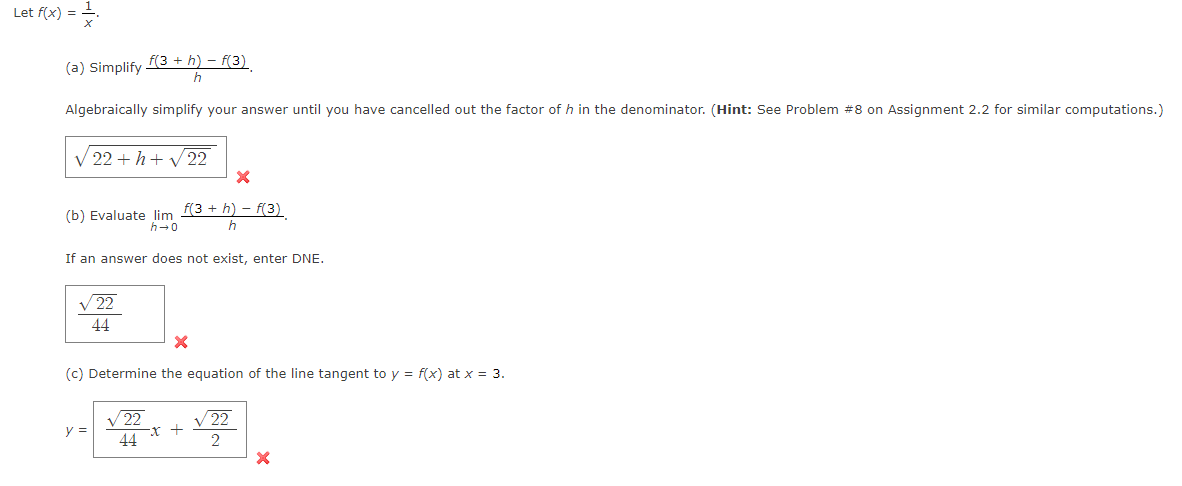
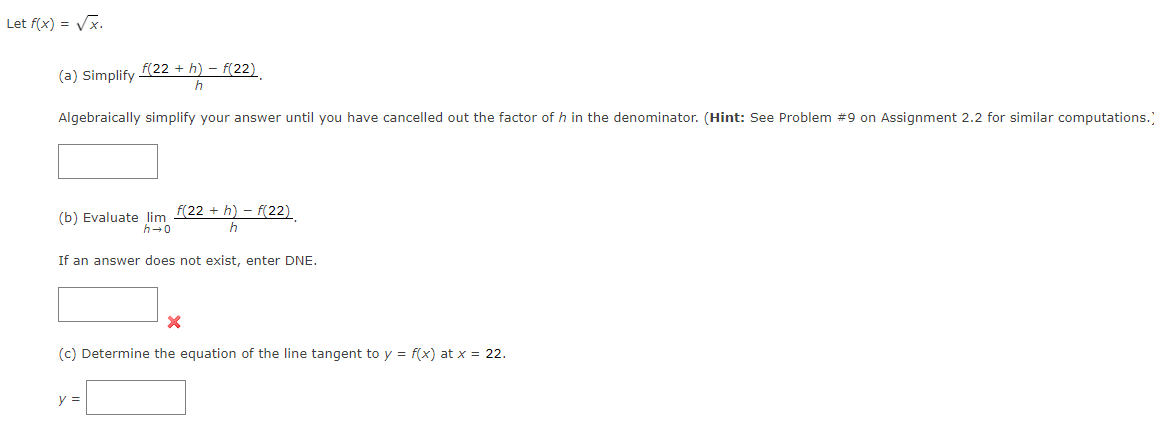
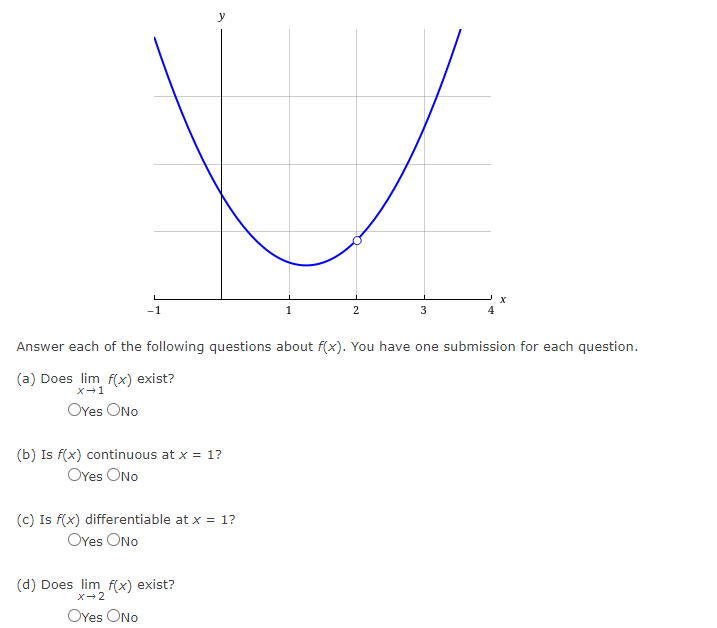
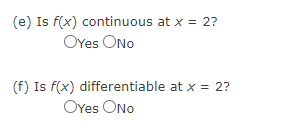
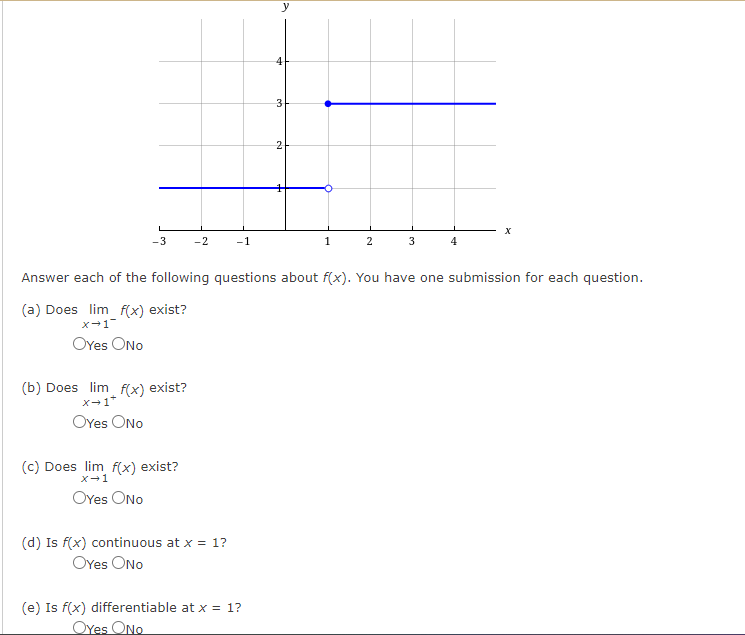
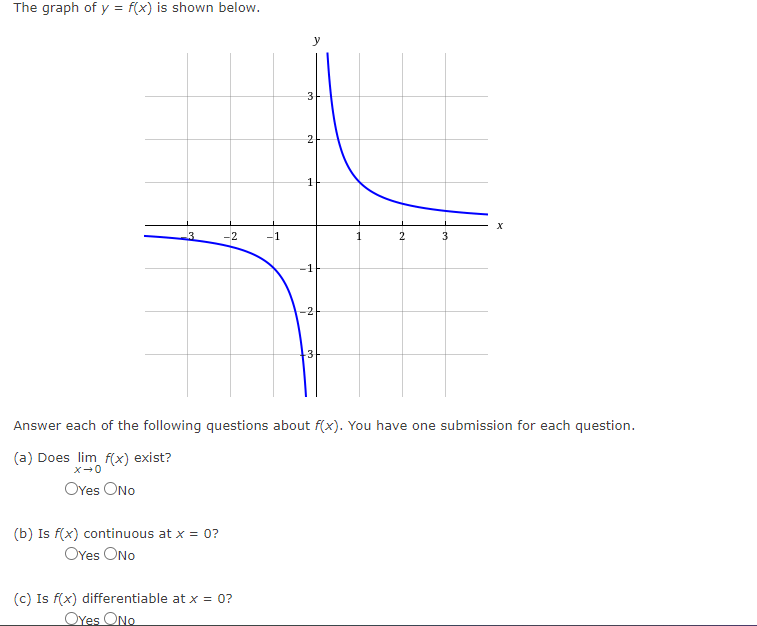
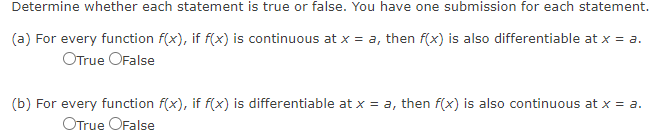
Let f(x) = _. (a) Simplify (3 + h) - f(3) h Algebraically simplify your answer until you have cancelled out the factor of h in the denominator. (Hint: See Problem #8 on Assignment 2.2 for similar computations.) V 22 + h + v 22 X (b) Evaluate lim f(3 + h) - 1(3) h -0 h If an answer does not exist, enter DNE. V 22 44 X (c) Determine the equation of the line tangent to y = f(x) at x = 3. V 22 y = x + V 22 44 2 XLet f{x) = v/x. (a) Simplify f22 + ) = f22) hh - f(22) Algebraically simplify your answer until you have cancelled out the factor of A in the denominator. (Hint: See Problem #9 on Assignment 2.2 for similar computations.' (b) Evaluate lim f22 + h) - A22) h=0 h If an answer does not exist, enter DME. b4 (c) Determine the equation of the line tangent to y = flx) at x = 22. 2 3 Answer each of the following questions about f(x). You have one submission for each question. (a) Does lim f(x) exist? x -1 OYes ONo (b) Is f(x) continuous at x = 1? OYes ONo (c) Is f(x) differentiable at x = 1? OYes ONo (d) Does lim f(x) exist? x - 2 OYes ONo\f4 3 21 -3 -2 -1 2 Answer each of the following questions about f(x). You have one submission for each question. (a) Does lim f(x) exist? x-17 OYes ONo (b) Does lim f(x) exist? x-17 OYes ONo (c) Does lim f(x) exist? OYes ONo (d) Is f(x) continuous at x = 1? OYes ONo (e) Is f(x) differentiable at x = 1? OYes ONOThe graph of y = f(x) is shown below. X -2 -1 -1 3 Answer each of the following questions about f(x). You have one submission for each question. (a) Does lim f(x) exist? x-0 OYes ONo (b) Is f(x) continuous at x = 0? OYes ONo (c) Is f(x) differentiable at x = 0? OYes ONaDetermine whether each statement is true or false. You have one submission for each statement. (a) For every function f(x), if f(x) is continuous at x = a, then f(x) is also differentiable at x = a. OTrue OFalse (b) For every function f(x), if f(x) is differentiable at x = a, then f(x) is also continuous at x = a. OTrue OFalse
Step by Step Solution
There are 3 Steps involved in it

Get step-by-step solutions from verified subject matter experts
 Study Help