







Question: Let G = ({S, A, B, C, D}, sigma, R, S) be the context-free grammar with sigma ={a, b} and rules R = S rightarrow
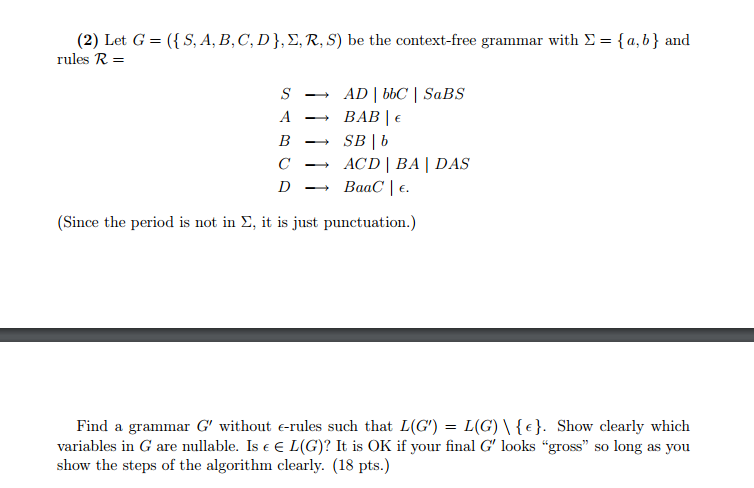
Let G = ({S, A, B, C, D}, sigma, R, S) be the context-free grammar with sigma ={a, b} and rules R = S rightarrow AD | bbC | SaBS A rightarrow BAB | elementof B rightarrow SB | b C rightarrow ACD | BA | DAS D rightarrow BaaC | elementof. (Since the period is not in sigma, it is just punctuation.) Find a grammar G' without elementof-rules such that L(G') = L(G) \ {elementof}. Show clearly which variables in G are nullable. Is elementof elementof L(G)? It is OK if your final G' looks "gross" so long as you show the steps of the algorithm clearly. Let G = ({S, A, B, C, D}, sigma, R, S) be the context-free grammar with sigma ={a, b} and rules R = S rightarrow AD | bbC | SaBS A rightarrow BAB | elementof B rightarrow SB | b C rightarrow ACD | BA | DAS D rightarrow BaaC | elementof. (Since the period is not in sigma, it is just punctuation.) Find a grammar G' without elementof-rules such that L(G') = L(G) \ {elementof}. Show clearly which variables in G are nullable. Is elementof elementof L(G)? It is OK if your final G' looks "gross" so long as you show the steps of the algorithm clearly
Step by Step Solution
There are 3 Steps involved in it

Get step-by-step solutions from verified subject matter experts
 Study Help