







Question: Let G = (V, E) be a directed graph with edge weights w : E R (which may be positive, negative, or zero), and let
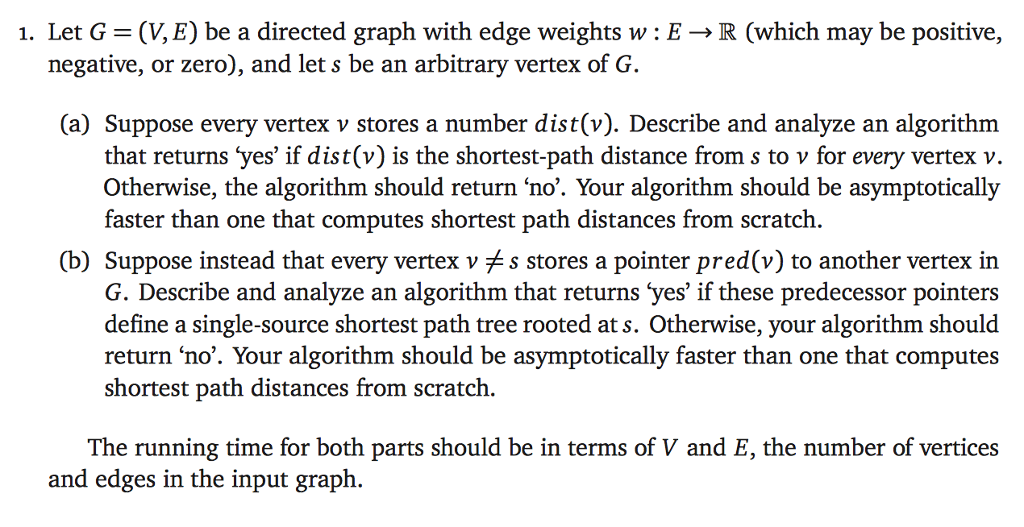
Let G = (V, E) be a directed graph with edge weights w : E R (which may be positive, negative, or zero), and let s be an arbitrary vertex of G. (a) Suppose every vertex v stores a number dist(v). Describe and analyze an algorithm that returns 'yes' if dist(v) is the shortest-path distance from s to v for every vertex v. Otherwise, the algorithm should return 'no'. Your algorithm should be asymptotically faster than one that computes shortest path distances from scratch. (b) Suppose instead that every vertex vs stores a pointer pred(v) to another vertex in G. Describe and analyze an algorithm that returns 'yes' if these predecessor pointers define a single-source shortest path tree rooted at s. Otherwise, your algorithm should return 'no'. Your algorithm should be asymptotically faster than one that computes The running time for both parts should be in terms of V and E, the number of vertices and edges in the input graph
Step by Step Solution
There are 3 Steps involved in it

Get step-by-step solutions from verified subject matter experts
 Study Help