







Question: Let G = (V, E) be a directed graph with n vertices and m edges. What is the worst time (big-O with parameters n and/or
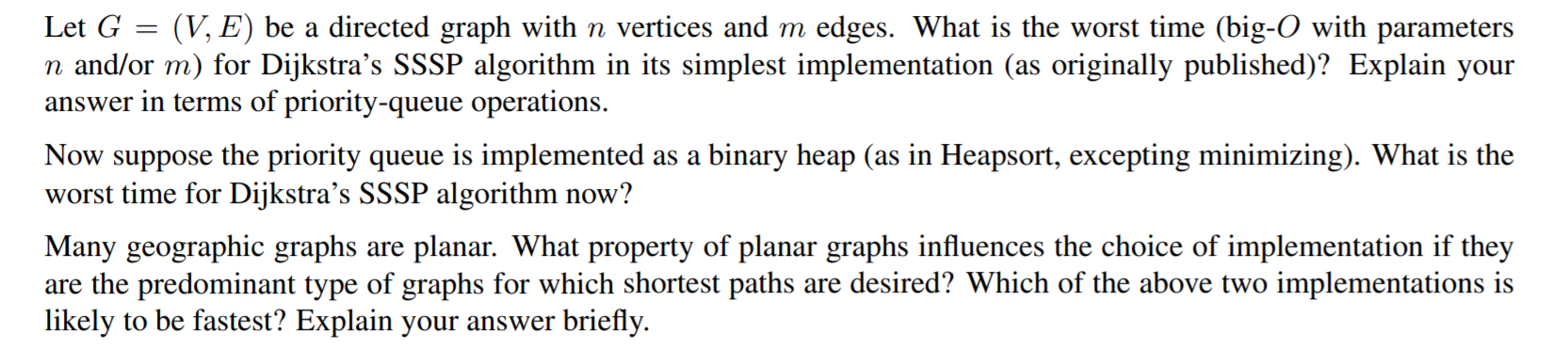
Let G = (V, E) be a directed graph with n vertices and m edges. What is the worst time (big-O with parameters n and/or m) for Dijkstra's SSSP algorithm in its simplest implementation (as originally published)? Explain your answer in terms of priority-queue operations. Now suppose the priority queue is implemented as a binary heap (as in Heapsort, excepting minimizing). What is the worst time for Dijkstra's SSSP algorithm now? Many geographic graphs are planar. What property of planar graphs influences the choice of implementation if they are the predominant type of graphs for which shortest paths are desired? Which of the above two implementations is likely to be fastest? Explain your answer briefly. Let G = (V, E) be a directed graph with n vertices and m edges. What is the worst time (big-O with parameters n and/or m) for Dijkstra's SSSP algorithm in its simplest implementation (as originally published)? Explain your answer in terms of priority-queue operations. Now suppose the priority queue is implemented as a binary heap (as in Heapsort, excepting minimizing). What is the worst time for Dijkstra's SSSP algorithm now? Many geographic graphs are planar. What property of planar graphs influences the choice of implementation if they are the predominant type of graphs for which shortest paths are desired? Which of the above two implementations is likely to be fastest? Explain your answer briefly
Step by Step Solution
There are 3 Steps involved in it

Get step-by-step solutions from verified subject matter experts
 Study Help