







Question: Let G = (V. E) be an undirected graph with all edge weights equal to I. Let d(i, j) denote the length of the shortest
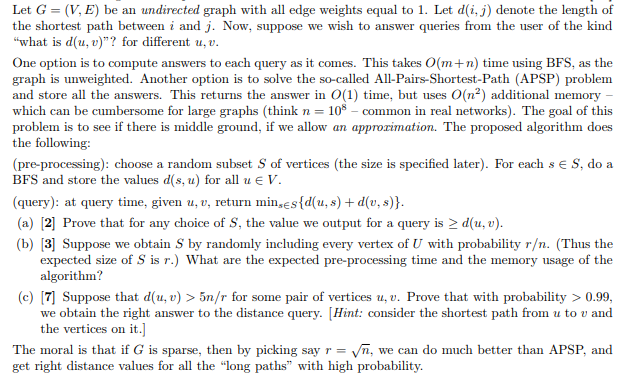
Let G = (V. E) be an undirected graph with all edge weights equal to I. Let d(i, j) denote the length of the shortest path between i and j. Now, suppose we wish to answer queries from the user of the kind what is d for different u, One option is to compute answers to each query as it comes. This takes O (mn time using BFS, as the graph is unweighted. Another option is to solve the so-called All-Pairs-Shortest-Path (APSP) problem and store all the answers. This returns the answer in (1) time, but uses O(n2) additional memory which can be cumbersome for large graphs (think n 10 comon in real networks). The goal of this problem is to see if there is middle ground, if we allow an approzimation. The proposed algorithm does the following (pre-processing): choose a random subset S of vertices (the size is specified later). For each s E S, do a BFS and store the values d(s, u) for all u E V (query): at query time, given u, v, return minsesId(u, s) + d(v, s)) a) 2] Prove that for any choice of S, the value we output for a query is 2 d(u, v) (b) [3] Suppose we obtain S by randomly including every vertex of U with probability r/m. (Thus the expected size of S is r.) What are the expected pre-processing time and the memory usage of the algorithm? c7 Suppose that d(u, v) > 5n/r for some pair of vertices u, v. Prove that with probability>0.99, we obtain the right answer to the distance query. Hint: consider the shortest path from u to v and the vertices on it.] The moral is that if G is sparse, then by picking say rvn, we can do much better than APSP, and get right distance values for all the "long paths" with high probability. Let G = (V. E) be an undirected graph with all edge weights equal to I. Let d(i, j) denote the length of the shortest path between i and j. Now, suppose we wish to answer queries from the user of the kind what is d for different u, One option is to compute answers to each query as it comes. This takes O (mn time using BFS, as the graph is unweighted. Another option is to solve the so-called All-Pairs-Shortest-Path (APSP) problem and store all the answers. This returns the answer in (1) time, but uses O(n2) additional memory which can be cumbersome for large graphs (think n 10 comon in real networks). The goal of this problem is to see if there is middle ground, if we allow an approzimation. The proposed algorithm does the following (pre-processing): choose a random subset S of vertices (the size is specified later). For each s E S, do a BFS and store the values d(s, u) for all u E V (query): at query time, given u, v, return minsesId(u, s) + d(v, s)) a) 2] Prove that for any choice of S, the value we output for a query is 2 d(u, v) (b) [3] Suppose we obtain S by randomly including every vertex of U with probability r/m. (Thus the expected size of S is r.) What are the expected pre-processing time and the memory usage of the algorithm? c7 Suppose that d(u, v) > 5n/r for some pair of vertices u, v. Prove that with probability>0.99, we obtain the right answer to the distance query. Hint: consider the shortest path from u to v and the vertices on it.] The moral is that if G is sparse, then by picking say rvn, we can do much better than APSP, and get right distance values for all the "long paths" with high probability
Step by Step Solution
There are 3 Steps involved in it

Get step-by-step solutions from verified subject matter experts
 Study Help