



Question: Let G = (V,E) be the following undirected graph: V = { 1, 2, 3, 4, 5, 6, 7, 8, 9, 10,11}, and E
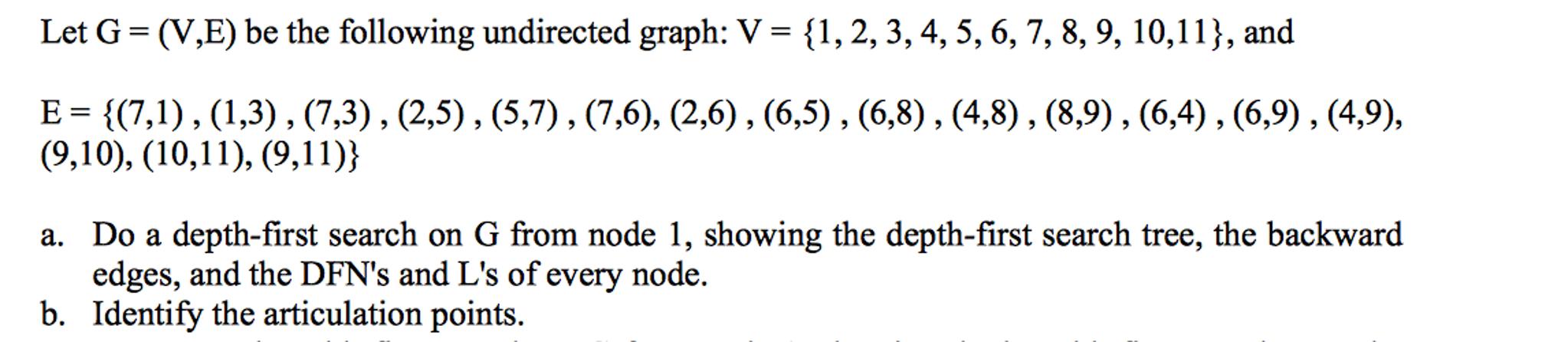
Let G = (V,E) be the following undirected graph: V = { 1, 2, 3, 4, 5, 6, 7, 8, 9, 10,11}, and E = {(7,1), (1,3), (7,3), (2,5), (5,7), (7,6), (2,6), (6,5), (6,8), (4,8), (8,9), (6,4), (6,9), (4,9), (9,10), (10,11), (9,11)} a. Do a depth-first search on G from node 1, showing the depth-first search tree, the backward edges, and the DFN's and L's of every node. b. Identify the articulation points.
Step by Step Solution
3.46 Rating (159 Votes )
There are 3 Steps involved in it
a DepthFirst Search DFS on Graph G from Node 1 DepthFirst Search is a traversal algorithm that ex... View full answer

Get step-by-step solutions from verified subject matter experts