



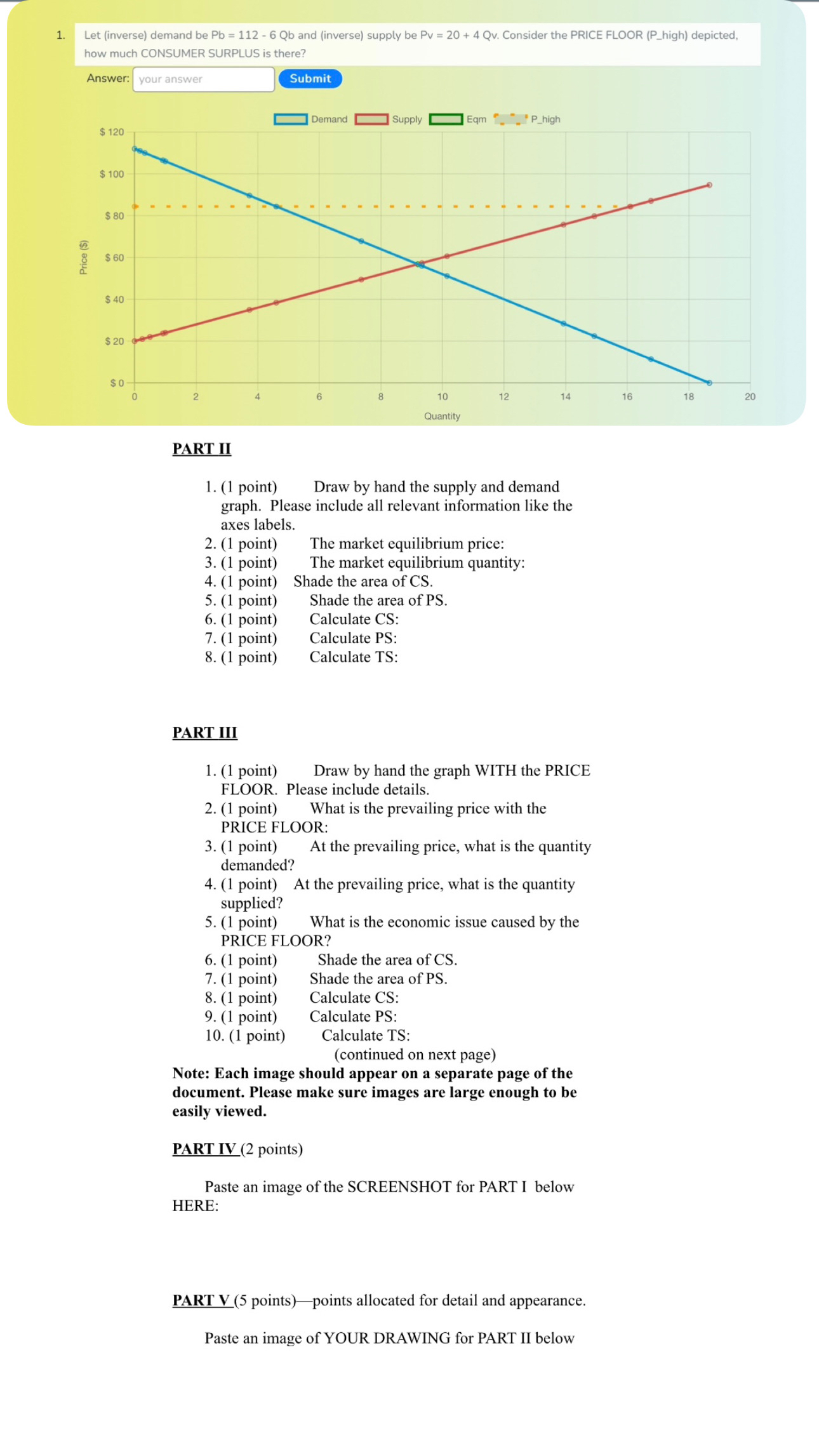
Question: Let ( inverse ) demand be P b = 1 1 2 - 6 Q b and ( inverse ) supply be P v =
Let inverse demand be and inverse supply be Consider the PRICE FLOOR Phigh depicted, how much CONSUMER SURPLUS is there?
Answer:
Submit
PART II
point Draw by hand the supply and demand graph. Please include all relevant information like the axes labels.
point The market equilibrium price:
point The market equilibrium quantity:
point Shade the area of CS
point Shade the area of PS
point Calculate CS:
point Calculate PS:
point Calculate TS:
PART III
point Draw by hand the graph WITH the PRICE FLOOR. Please include details.
point What is the prevailing price with the PRICE FLOOR:
point At the prevailing price, what is the quantity demanded?
point At the prevailing price, what is the quantity supplied?
point What is the economic issue caused by the PRICE FLOOR?
point Shade the area of CS
point Shade the area of PS
point Calculate CS:
point Calculate PS:
point Calculate TS: continued on next page
Note: Each image should appear on a separate page of the document. Please make sure images are large enough to be easily viewed.
PART IV points
Paste an image of the SCREENSHOT for PART I below HERE:
PART V pointspoints allocated for detail and appearance.
Paste an image of YOUR DRAWING for PART II below
Step by Step Solution
There are 3 Steps involved in it
1 Expert Approved Answer
Step: 1 Unlock

Question Has Been Solved by an Expert!
Get step-by-step solutions from verified subject matter experts
Step: 2 Unlock
Step: 3 Unlock