







Question: Let k be a positive integer and let be a continuous random variable that is uniformly distributed on [0, k]. For any number x,
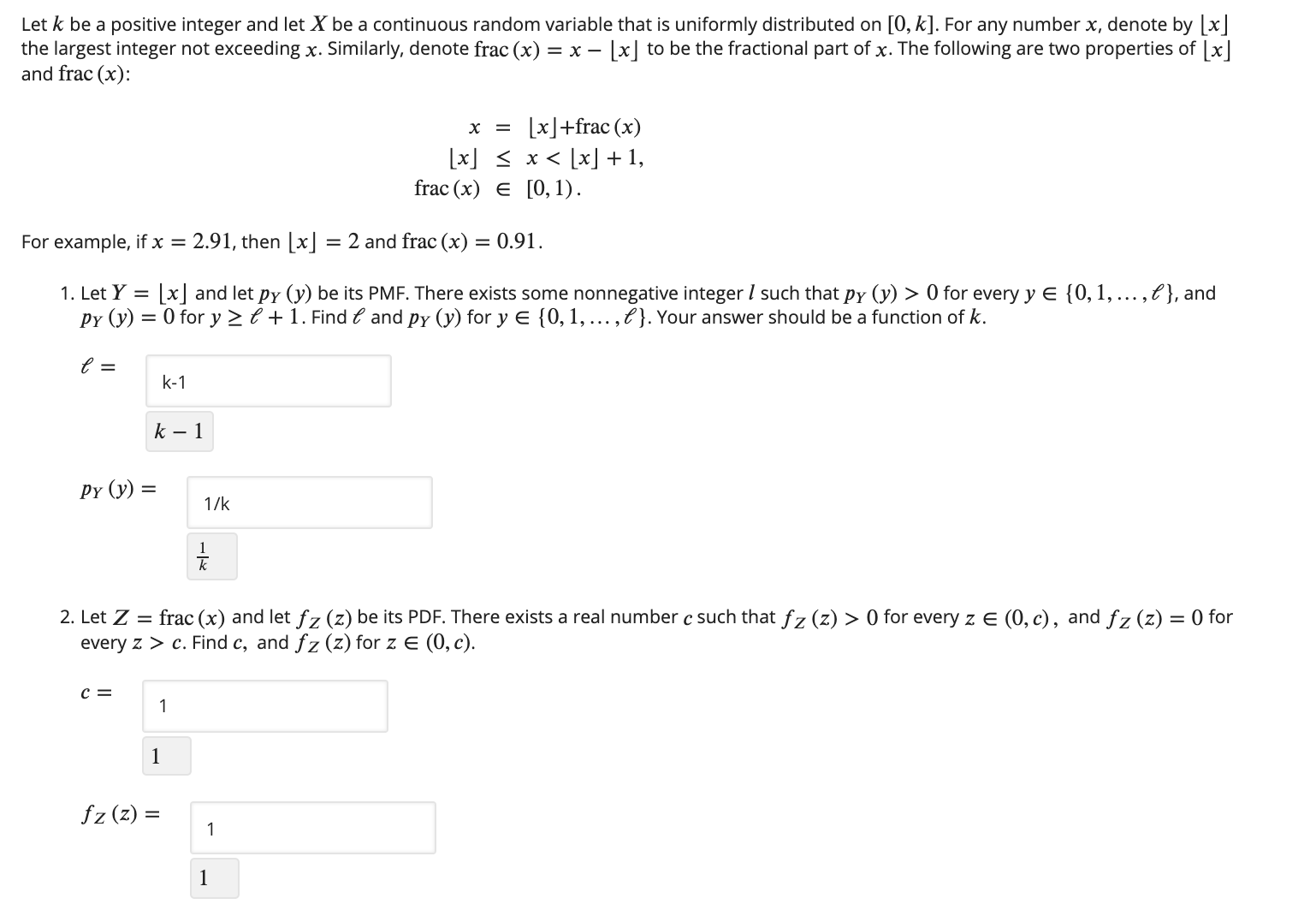
Let k be a positive integer and let be a continuous random variable that is uniformly distributed on [0, k]. For any number x, denote by [x] the largest integer not exceeding x. Similarly, denote frac (x) = x - [x] to be the fractional part of x. The following are two properties of [x] and frac (x): x = [x]+frac (x) [x] x < [x] + 1, frac (x) = [0, 1). For example, if x = 2.91, then [x] = 2 and frac (x) = 0.91. 1. Let Y = [x] and let py (y) be its PMF. There exists some nonnegative integer / such that py (y) > 0 for every y = {0, 1, ..., }, and Py (y) = 0 for y l + 1. Find C and py (y) for y = {0, 1, ..., }. Your answer should be a function of k. l = PY (y) = k-1 k-1 1/k 1/4 k 2. Let Z = frac (x) and let fz (z) be its PDF. There exists a real number c such that fz (z) > 0 for every z = (0, c), and fz (z) = 0 for c. Find c, and fz (z) for z = (0, c). every z C = 1 fz (z) = 1 1 1
Step by Step Solution
There are 3 Steps involved in it

Get step-by-step solutions from verified subject matter experts
 Study Help