







Question: Let N={0,1,2,dots} and let psi be a function from Ntimes N into N such that R1psi (a,0)=a+1 R2psi (0,b+1)=psi (1,b) R3psi (a+1,b+1)=psi (psi (a,b+1),b)
Let
N={0,1,2,dots}and let
\\\\psi be a function from
N\\\\times Ninto
Nsuch that\
R1\\\\psi (a,0)=a+1\ R2\\\\psi (0,b+1)=\\\\psi (1,b)\ R3\\\\psi (a+1,b+1)=\\\\psi (\\\\psi (a,b+1),b)\ (1) Find
\\\\psi (2,1).\ (2) Show that for all
a,binN,\\\\psi (a,b)can be calculated in a finite number of steps using (R1),(R2), and (R3). (Hint: Use double induction. Let
S(b)say: For all
ainN,
\\\\psi (a,b)can be calculated in a finite number of steps using (R1), (R2), and (R3). Prove
S(b)by induction. In proving
S(b+1), let
T(a)say:
\\\\psi (a,b+1)can be calculated in a finite number of steps using (R1), (R2), and (R3). Prove
T(a)by induction.)\ (3) Guess at, and then prove by induction, a formula for
\\\\psi (a,2).\ (4) Find
\\\\psi (5,4).
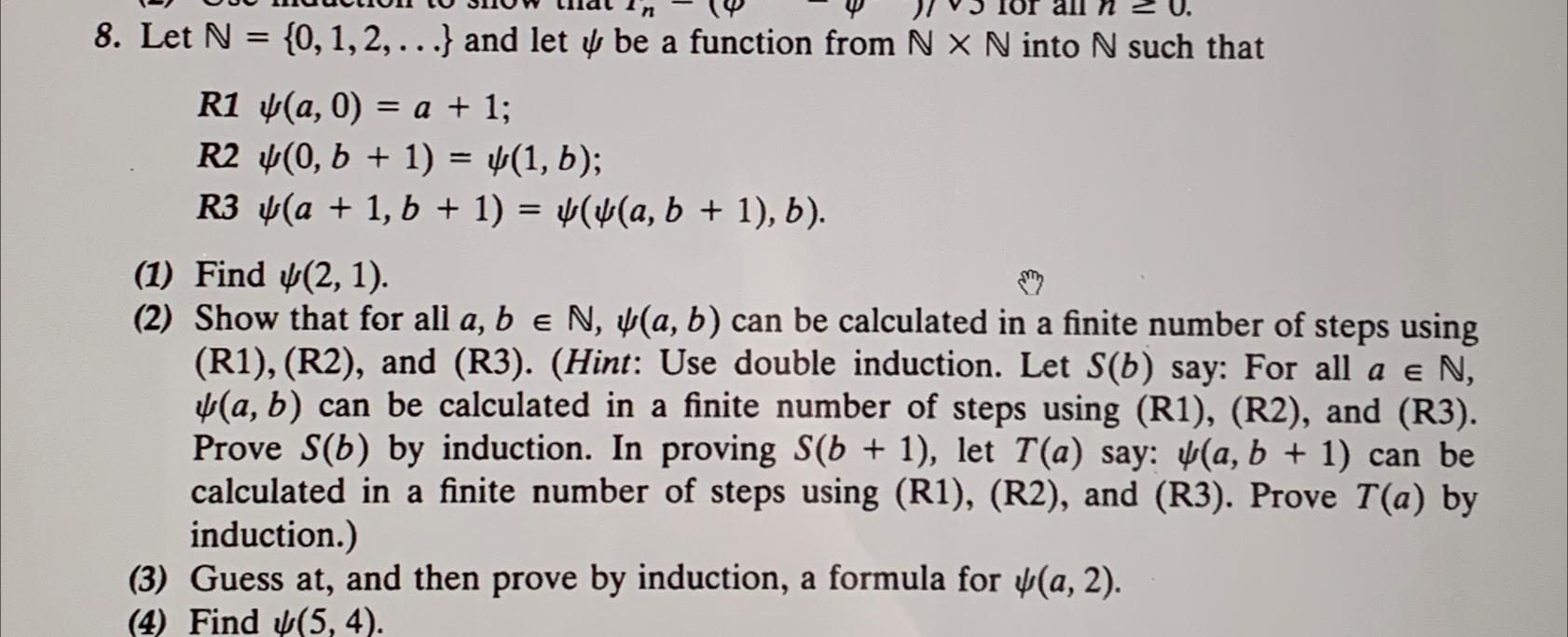
8. Let N={0,1,2,} and let be a function from NN into N such that R1(a,0)=a+1R2(0,b+1)=(1,b);R3(a+1,b+1)=((a,b+1),b). (1) Find (2,1). (2) Show that for all a,bN,(a,b) can be calculated in a finite number of steps using (R1), (R2), and (R3). (Hint: Use double induction. Let S(b) say: For all aN, (a,b) can be calculated in a finite number of steps using (R1), (R2), and (R3). Prove S(b) by induction. In proving S(b+1), let T(a) say: (a,b+1) can be calculated in a finite number of steps using (R1), (R2), and (R3). Prove T(a) by induction.) (3) Guess at, and then prove by induction, a formula for (a,2). (4) Find (5,4)
Step by Step Solution
There are 3 Steps involved in it

Get step-by-step solutions from verified subject matter experts
 Study Help