







Question: Let P denote the set of polynomials with integer coefficients, i.e., functions R rightarrow R of form a_0 + a_1 x + a_2 x^2 +
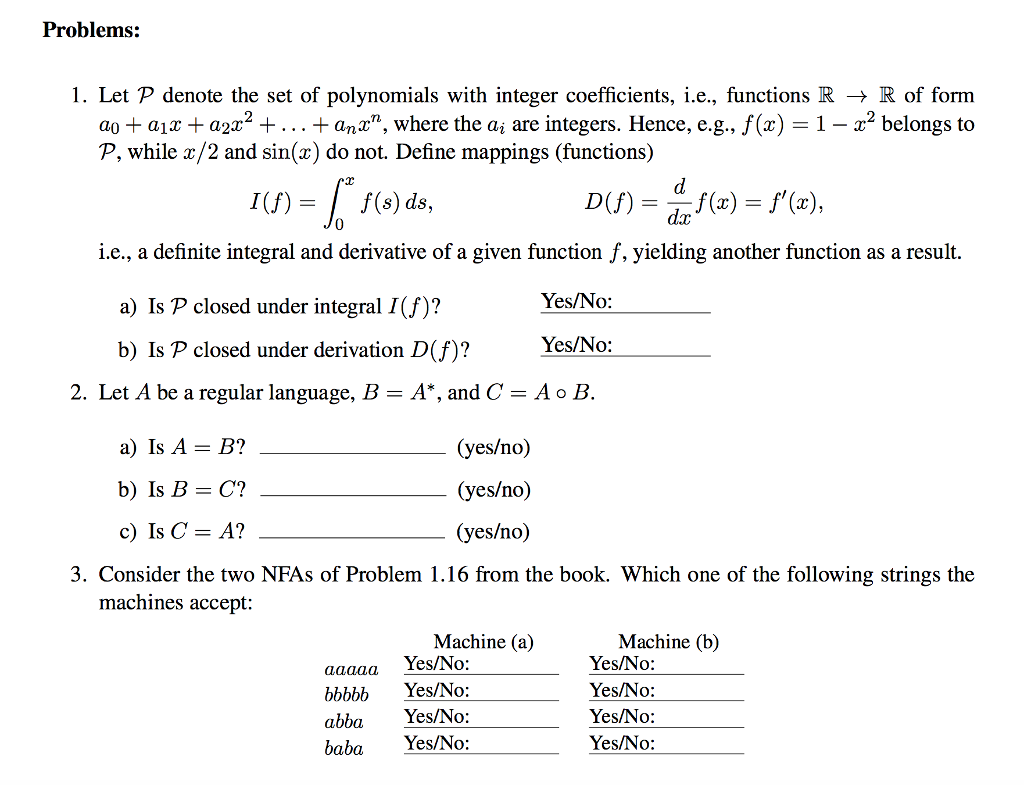
Let P denote the set of polynomials with integer coefficients, i.e., functions R rightarrow R of form a_0 + a_1 x + a_2 x^2 + ... + a_n x^n, where the a_i are integers. Hence, e.g., f (x) = 1 - x^2 belongs to P, while x/2 and sin(x) do not. Define mappings (functions) I(f) = integral^x _0 f (s) ds, D (f) = d/dx f (x) = f' (x), i.e., a definite integral and derivative of a given function f, yielding another function as a result. a) Is P closed under integral I (f)? Yes/No: b) Is P closed under derivation D(f)? Yes/No: Let A be a regular language, B = A*, and C = A compositefunction B. a) Is A = B? ___ (yeso) b) Is B = C? ______ (yeso) c) Is C = A? _____ (yeso) Consider the two NFAs of Problem 1.16 from the book. Which one of the following strings the machines accept
Step by Step Solution
There are 3 Steps involved in it

Get step-by-step solutions from verified subject matter experts
 Study Help