







Question: Let P(X) be the predicate x is a dragon. Let Q(x) be the predicate x breathes fire. Let R(x, y) be the predicate x
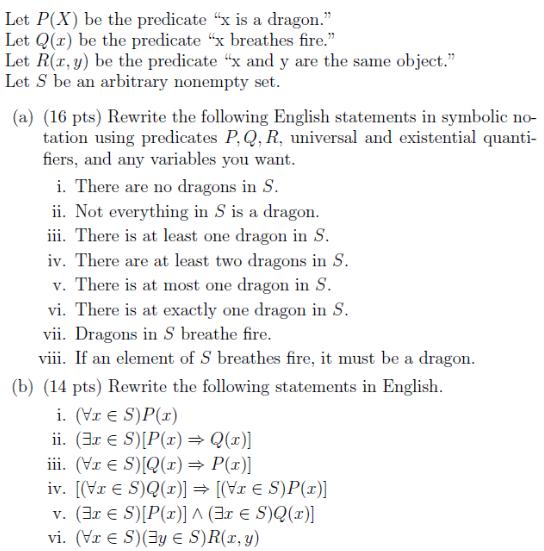
Let P(X) be the predicate "x is a dragon." Let Q(x) be the predicate "x breathes fire." Let R(x, y) be the predicate "x and y are the same object." Let S be an arbitrary nonempty set. (a) (16 pts) Rewrite the following English statements in symbolic no- tation using predicates P, Q, R, universal and existential quanti- fiers, and any variables you want. i. There are no dragons in S. ii. Not everything in S is a dragon. iii. There is at least one dragon in S. iv. There are at least two dragons in S. v. There is at most one dragon in S. vi. There is at exactly one dragon in S. vii. Dragons in S breathe fire. viii. If an element of S breathes fire, it must be a dragon. (b) (14 pts) Rewrite the following statements in English. i. (Vx S)P(x) ii. (S)[P(x) = Q(x)] iii. (VS)[Q(x) = P(x)] iv. [(VS)Q(x)] = [(Vx S)P(x)] v. (3xS)[P(x)] ^ (31 S)Q(x)] vi. (VxS)(y = S)R(x, y)
Step by Step Solution
There are 3 Steps involved in it

Get step-by-step solutions from verified subject matter experts
 Study Help