







Question: Let P(x) represent the statement: x is a prime number. The truth values for different values of x would be: P(2) T P(3) T P(4)
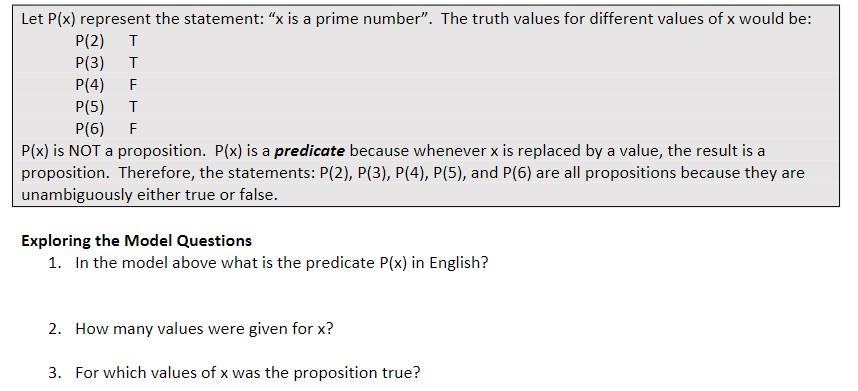
Let P(x) represent the statement: "x is a prime number". The truth values for different values of x would be: P(2) T P(3) T P(4) F P(5) T P(6) F P(x) is NOT a proposition. P(x) is a predicate because whenever x is replaced by a value, the result is a proposition. Therefore, the statements: P(2), P(3), P(4), P(5), and P(6) are all propositions because they are unambiguously either true or false. Exploring the Model Questions 1. In the model above what is the predicate P(x) in English? 2. How many values were given for x? 3. For which values of x was the proposition true
Step by Step Solution
There are 3 Steps involved in it
1 Expert Approved Answer
Step: 1 Unlock

Question Has Been Solved by an Expert!
Get step-by-step solutions from verified subject matter experts
Step: 2 Unlock
Step: 3 Unlock
 Study Help