







Question: Let q = a + bi + cj + dk be a unit quaternion with b, c, d not all 0, and let f: R'
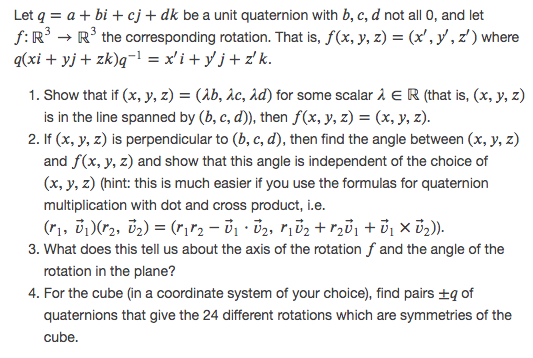
Let q = a + bi + cj + dk be a unit quaternion with b, c, d not all 0, and let f: R' - R' the corresponding rotation. That is, f(x, y, z) = (x , y , z' ) where q(xi + yj + zk)q-1 = x'i+ y j + z'k. 1. Show that if (x, y, z) = (1b, Ac, Ad) for some scalar ) E R (that is, (x, y, z) is in the line spanned by (b, c, d)), then f(x, y, z) = (x, y, z). 2. If (x, y, z) is perpendicular to (b, c, d), then find the angle between (x, y, z) and f(x, y, z) and show that this angle is independent of the choice of (x, y, z) (hint: this is much easier if you use the formulas for quaternion multiplication with dot and cross product, i.e. (1, D )(r2, D2) = (172 - U1 . U2, F102 + 201 + DI XD2)). 3. What does this tell us about the axis of the rotation f and the angle of the rotation in the plane? 4. For the cube (in a coordinate system of your choice), find pairs +q of quaternions that give the 24 different rotations which are symmetries of the cube
Step by Step Solution
There are 3 Steps involved in it

Get step-by-step solutions from verified subject matter experts
 Study Help