







Question: = Let Q {q} be an orthonormal basis for a subspace V of R. a) Prove that if vV and v-q=0 for all i
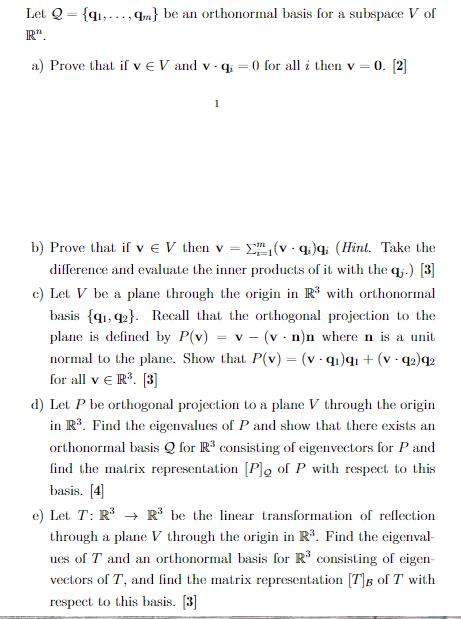
= Let Q {q} be an orthonormal basis for a subspace V of R". a) Prove that if vV and v-q=0 for all i then v = 0. [2] 1 b) Prove that if v V then v = (v qq (Hint. Take the difference and evaluate the inner products of it with the qj.) [3] c) Let V be a plane through the origin in R3 with orthonormal basis (q1,q2}. Recall that the orthogonal projection to the plane is defined by P(v) = v(v n)n where n is a unit normal to the plane. Show that P(v) = (v qi)q+(v q2)92 for all v R. [3] d) Let P be orthogonal projection to a plane V through the origin. in R. Find the eigenvalues of P and show that there exists an orthonormal basis Q for R consisting of eigenvectors for P and find the matrix representation [P]o of P with respect to this basis. [4] e) Let T: R R be the linear transformation of reflection through a plane V through the origin in R. Find the eigenval- ues of T and an orthonormal basis for R consisting of eigen- vectors of T, and find the matrix representation [T]B of T with respect to this basis. [3]
Step by Step Solution
3.50 Rating (157 Votes )
There are 3 Steps involved in it

Get step-by-step solutions from verified subject matter experts
 Study Help