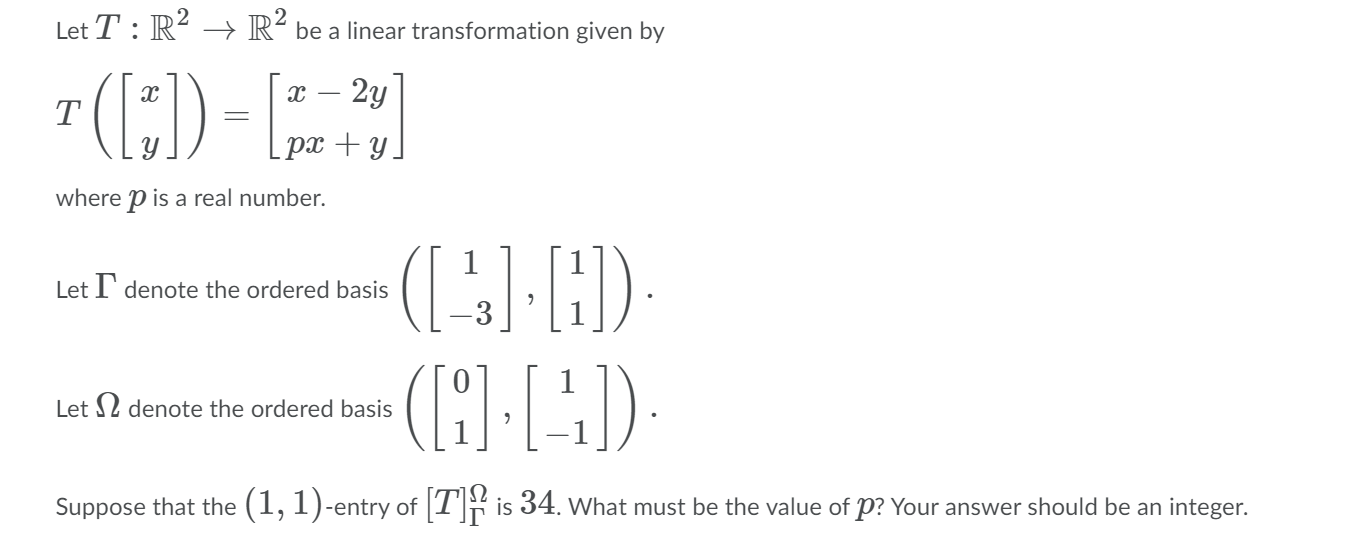
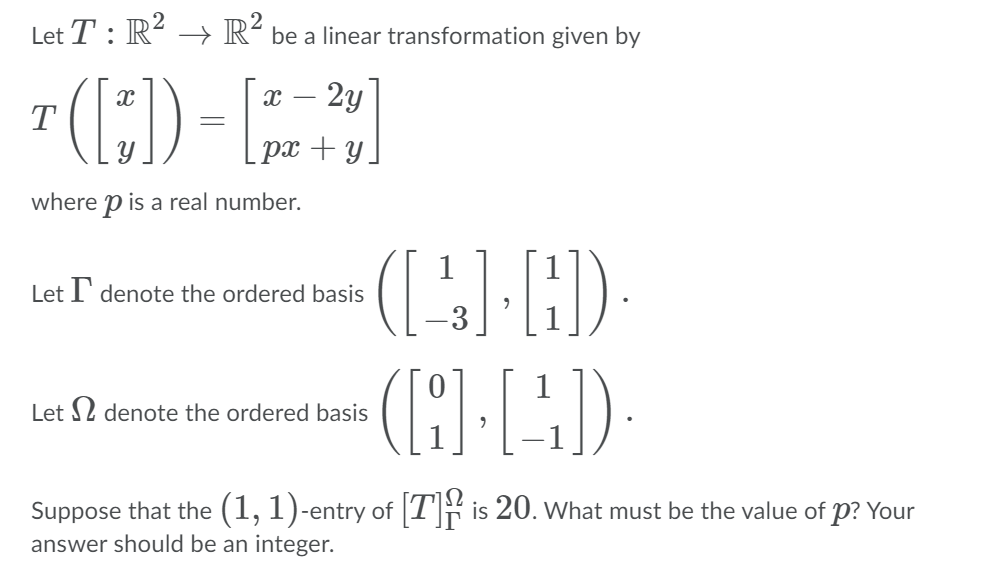
Question: Let T 2 R2 > R2 be a linear transformation given by Tiiii) = [1:33] wherep is a real number. ( i 1 i i
Let T 2 R2 > R2 be a linear transformation givenLet T 2 R2 > R2 be a linear transformation givenLet T 2 R2 > R2 be a linear transformation givenLet T 2 R2 > R2 be a linear transformation givenLet T 2 R2 > R2 be a linear transformation givenLet T 2 R2 > R2 be a linear transformation givenLet T 2 R2 > R2 be a linear transformation givenLet T 2 R2 > R2 be a linear transformation givenLet T 2 R2 > R2 be a linear transformation givenLet T 2 R2 > R2 be a linear transformation givenLet T 2 R2 > R2 be a linear transformation givenLet T 2 R2 > R2 be a linear transformation givenLet T 2 R2 > R2 be a linear transformation givenLet T 2 R2 > R2 be a linear transformation givenLet T 2 R2 > R2 be a linear transformation given
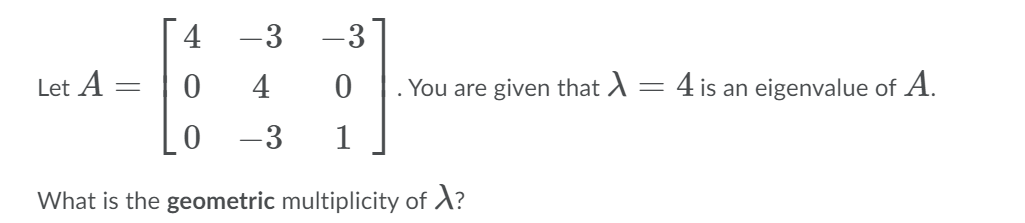
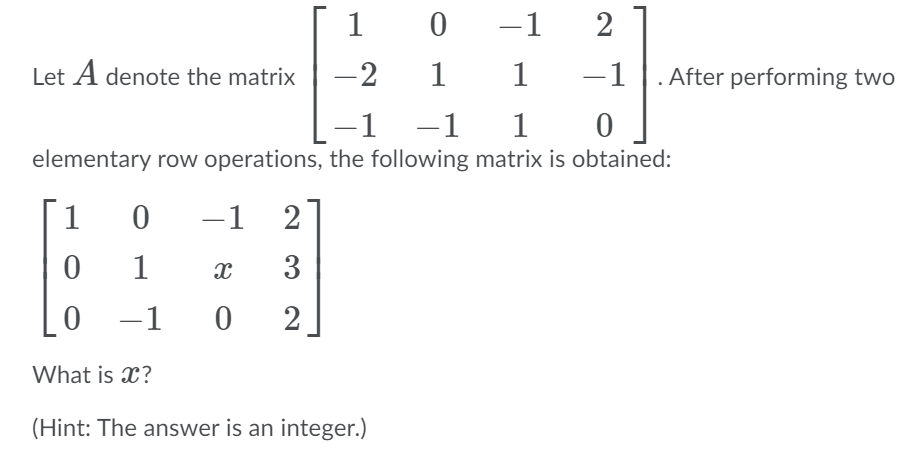
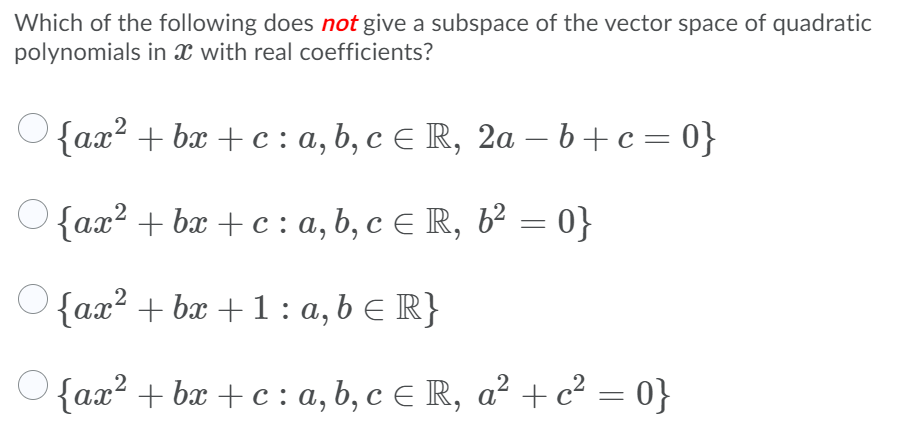
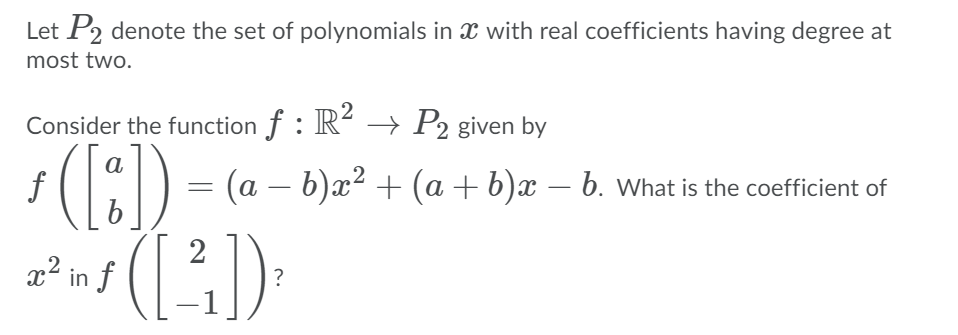
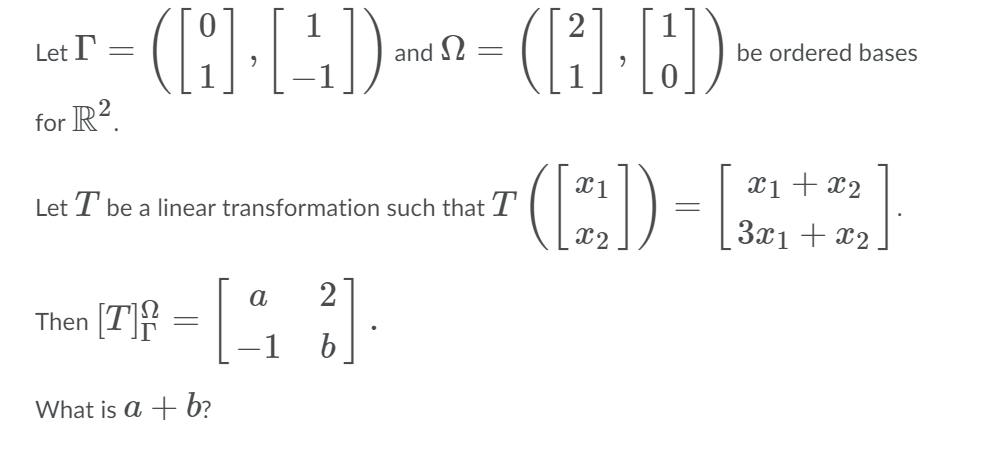
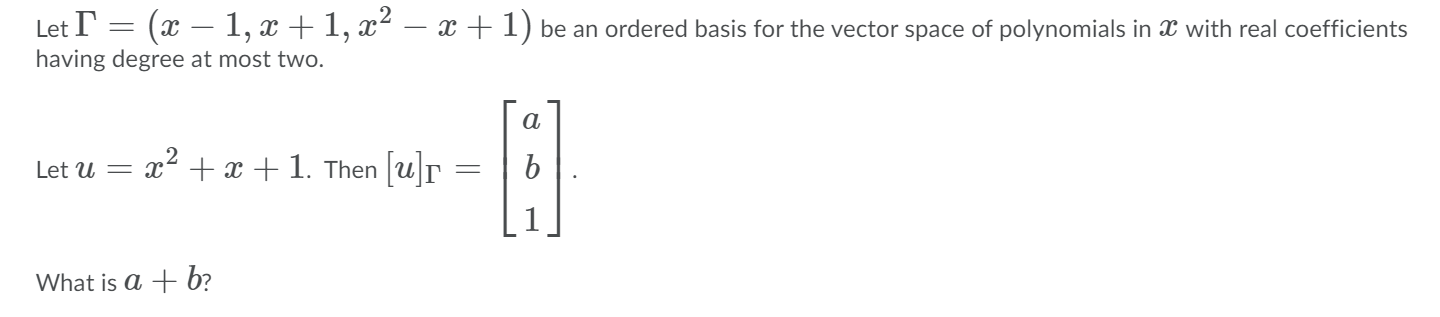
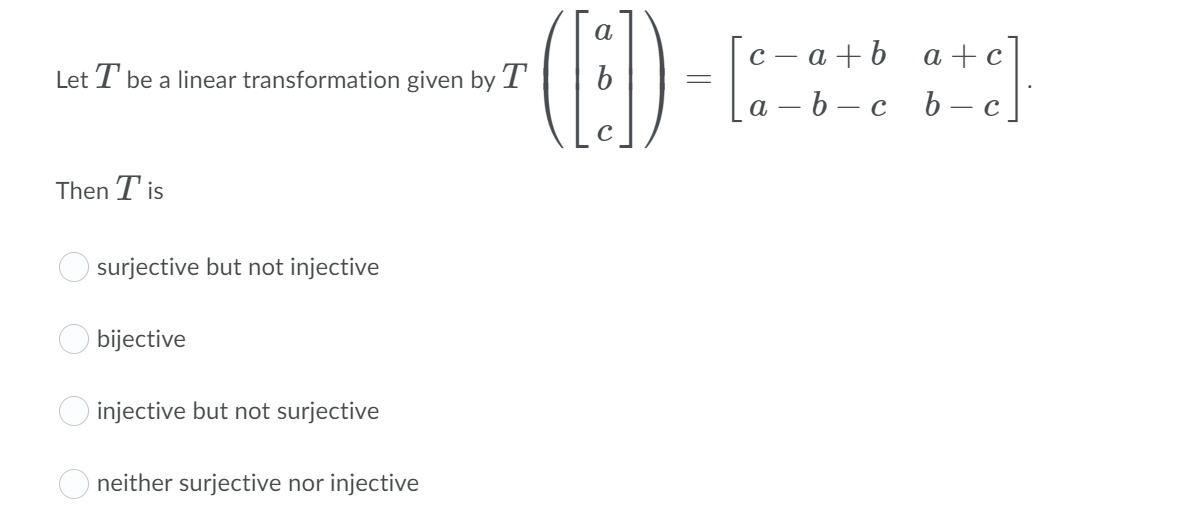
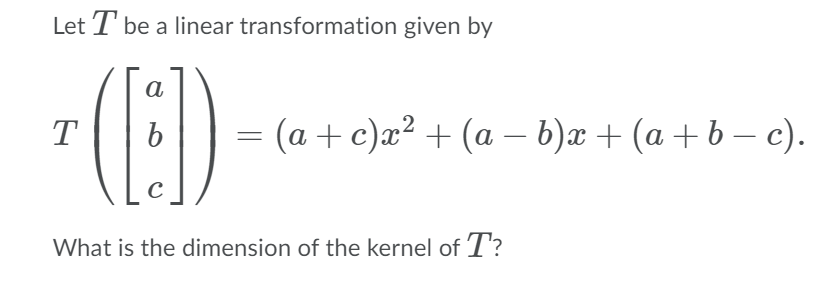
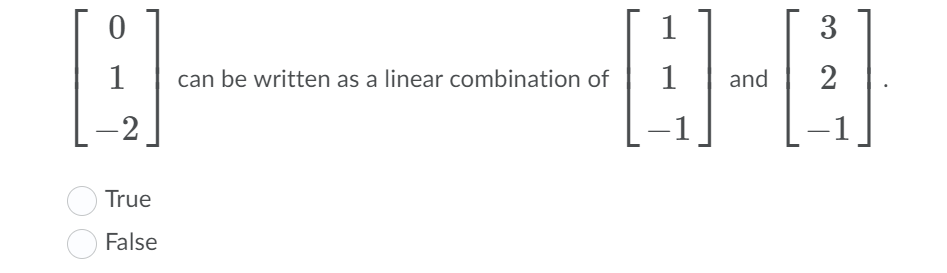
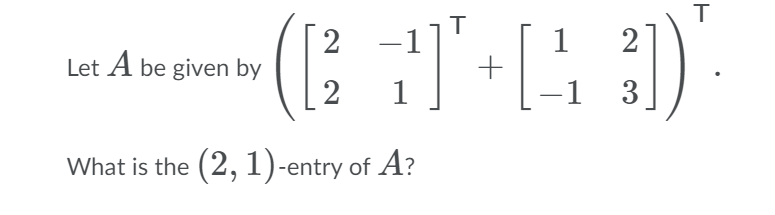
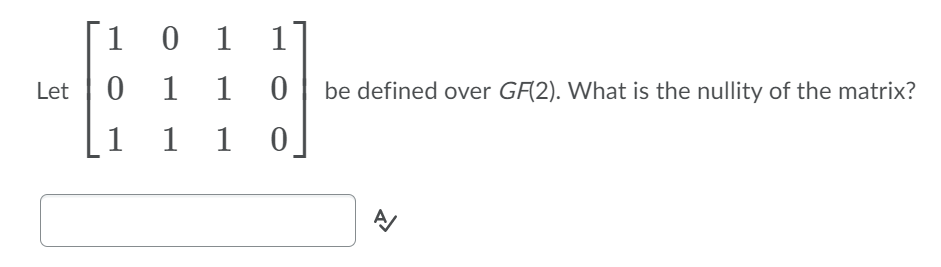
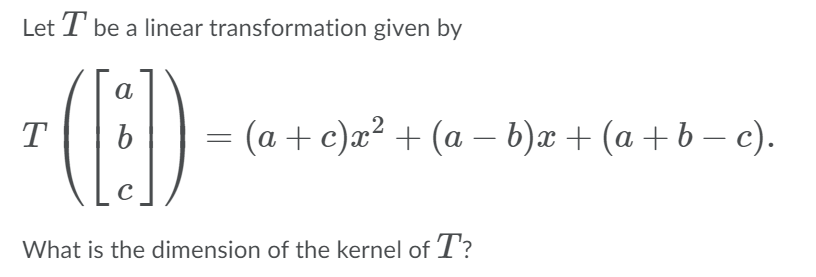
Let T 2 R2 > R2 be a linear transformation given by Tiiii) = [1:33] wherep is a real number. ( i 1 i i 1 i i Let F denote the ordered basis , . 3 1 ( P] i 1 i ) Let 9 denote the ordered basis 1 , 1 . Suppose that the (1, 1)-entry of [T]?2 is 20. What must be the value of p? Your answer should be an integer. 0 1 - - Let 0 1 1 0 be defined over GF(2). What is the nullity of the matrix? 1 1 1 0Let T be a linear transformation given by a. T b :(a+c)$2+(ab)x+(a+bc). c What is the dimension of the kernel of T? 4 3 3 Let A : 0 4 0 .You are given that A : 415 an eigenvalue of A. O 3 1 What is the geometric multiplicity of A? 1 0 1 2 Let A denote the matrix 2 1 1 1 . After performing two 1 1 1 0 elementary row operations, the following matrix is obtained: 1 0 1 2 0 1 :1: 3 O 1 0 2 What is it? (Hint: The answer is an integer.) Which of the following does not give a subspace of the vector Space of quadratic polynomials in :13 with real coefficients? O{am2+b$+c:a,b,cER, 2ab+c=0} O{a$2+b$+c:a,b,cR, b2 =0} O{a$2+b$+1:a,bER} O{a$2+b$+c:a,b,cR, a2+c2=0} Let P2 denote the set of polynomials in :1} with real coefficients having degree at most two. Consider the function f i R2 > P2 given by f ([2]) = (a _ E30132 + ((1 + (3)3: b. What is the coefficient of Wm Let T = and $2 = be ordered bases for RR2 Let T' be a linear transformation such that I 21 + 2 20 2 3x1 + 2 a 2 Then T]2 -1 b What is a + b?Let P = (E 1, :B + 1, 1132 23 + 1) be an ordered basis for the vector space of polynomials in :13 with real coefficients having degree at most two. Let'u, = $2 | :1: + 1. Then [uhw = I'U'Q What is a + b? Let P2 denote the set of polynomials in :13 with real coefficients having degree at most two. (L Consider the function f I R2 % P2 given by f ([b] ) : (a, f 110332 + ((1 Jr b)$ * b. What is the coefficient of {email} \fLet T : R -> R be a linear transformation given by ([:])- x - 2y Lpaty. where P is a real number. Let I denote the ordered basis Let 2 denote the ordered basis Suppose that the (1, 1 )-entry of It is 34. What must be the value of p? Your answer should be an integer.Let T be a linear transformation given by a T b :(a+c)m2+(ab)m+(a+bc). c What is the dimension of the kernel of T? \f\f
Step by Step Solution

There are 3 Steps involved in it

1 Expert Approved Answer
Step: 1 Unlock blur-text-image

Question Has Been Solved by an Expert!

Get step-by-step solutions from verified subject matter experts

Step: 2 Unlock
Step: 3 Unlock

Students Have Also Explored These Related Mathematics Questions!