





Question: Let the model be: Yi = B1 + B2.1; + i i = 1,...,n but suppose you are missing data on the nth observation of
Let the model be: Yi = B1 + B2.1; + i i = 1,...,n

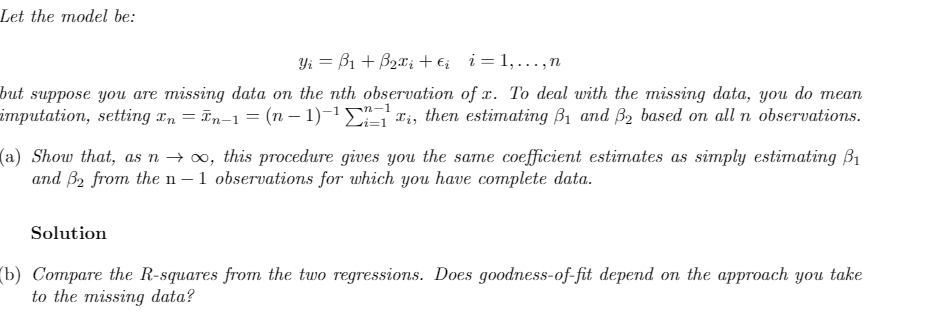
Let the model be: Yi = B1 + B2.1; + i i = 1,...,n but suppose you are missing data on the nth observation of 1. To deal with the missing data, you do mean imputation, setting in = cn-1 = (n 1)-2 2-1 Ii, then estimating B1 and B2 based on all n observations. (a) Show that, as n + , this procedure gives you the same coefficient estimates as simply estimating B1 and B2 from the n-1 observations for which you have complete data. Solution (b) Compare the R-squares from the two regressions. Does goodness-of-fit depend on the approach you take to the missing data? Let the model be: Yi = B1 + B2.1; + i i = 1,...,n but suppose you are missing data on the nth observation of 1. To deal with the missing data, you do mean imputation, setting in = cn-1 = (n 1)-2 2-1 Ii, then estimating B1 and B2 based on all n observations. (a) Show that, as n + , this procedure gives you the same coefficient estimates as simply estimating B1 and B2 from the n-1 observations for which you have complete data. Solution (b) Compare the R-squares from the two regressions. Does goodness-of-fit depend on the approach you take to the missing data

Step by Step Solution

There are 3 Steps involved in it

1 Expert Approved Answer
Step: 1 Unlock blur-text-image

Question Has Been Solved by an Expert!

Get step-by-step solutions from verified subject matter experts

Step: 2 Unlock
Step: 3 Unlock

Students Have Also Explored These Related General Management Questions!