







Question: 2. Let there be a set of sample points E, E2,..., Es, such that P(E) = 0.12 P(E2) = 0.06 P(E3) = 0.15 P(E5)
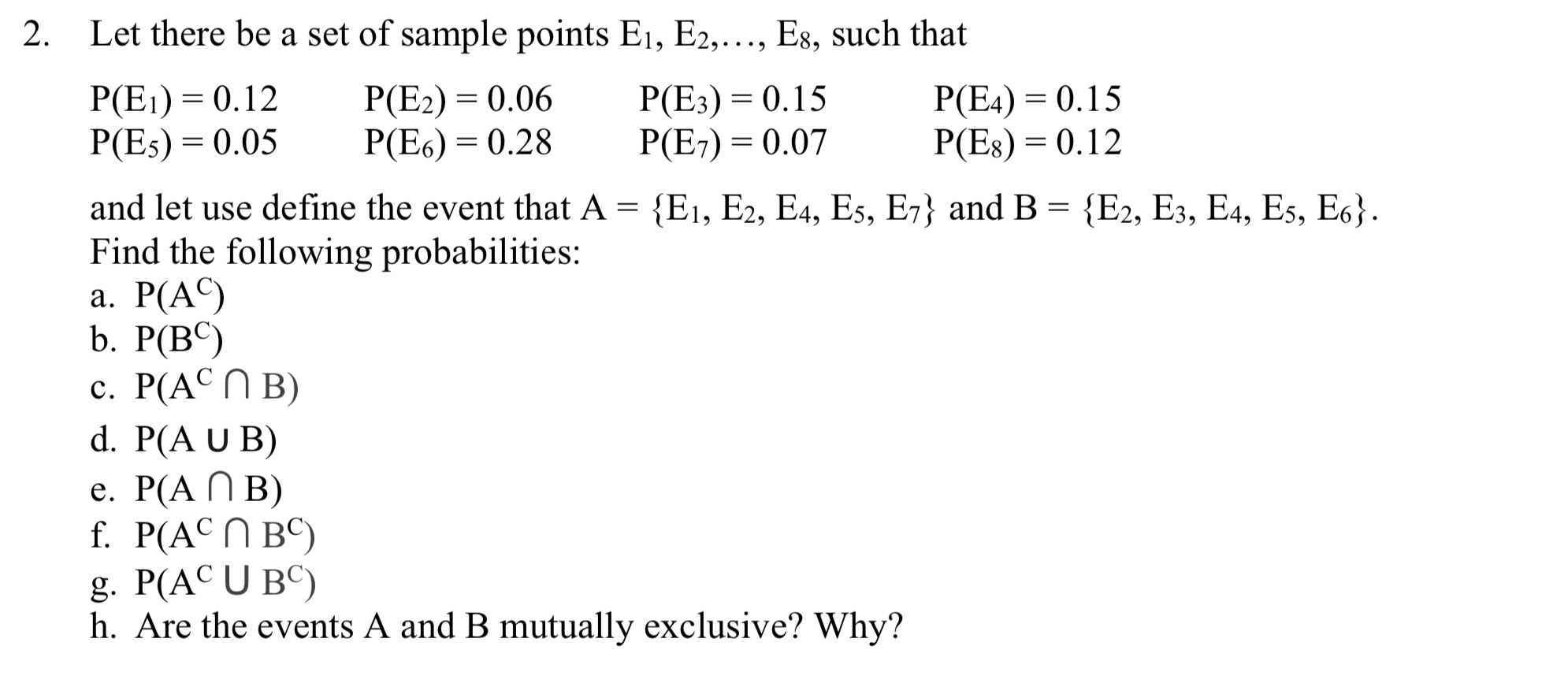
2. Let there be a set of sample points E, E2,..., Es, such that P(E) = 0.12 P(E2) = 0.06 P(E3) = 0.15 P(E5) = 0.05 P(E6) = 0.28 P(E7) = 0.07 P(E4) = 0.15 P(E8) = 0.12 and let use define the event that A = {E1, E2, E4, E5, E7} and B = {E2, E3, E4, E5, E6}. Find the following probabilities: a. P(AC) b. P(BC) c. P(ACB) d. P(A U B) e. P(ANB) f. P(ACN BC) g. P(AC U BC) h. Are the events A and B mutually exclusive? Why?
Step by Step Solution
3.41 Rating (151 Votes )
There are 3 Steps involved in it
To solve these probability problems we first define barA and barB the complements of A and B respect... View full answer

Get step-by-step solutions from verified subject matter experts
 Study Help