







Question: Let us consider the following cryptosystem: P ={a, b, c}; K = {k1, k2, k3}; C = {1, 2, 3, 4}; Pr(a) = 1/4;
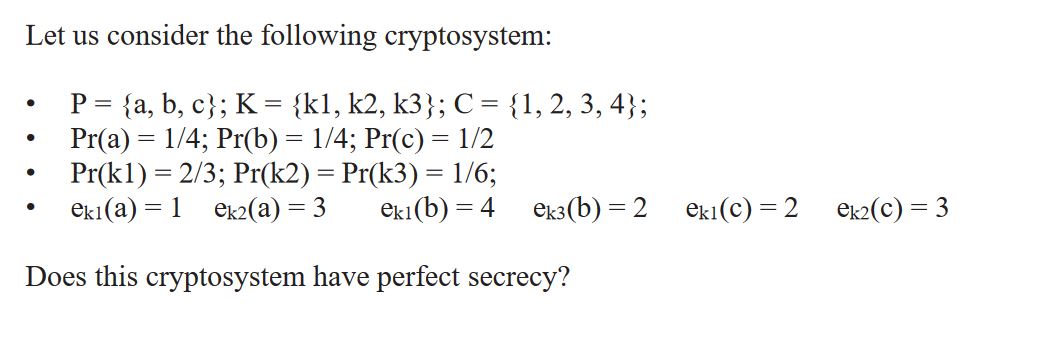
Let us consider the following cryptosystem: P ={a, b, c}; K = {k1, k2, k3}; C = {1, 2, 3, 4}; Pr(a) = 1/4; Pr(b) = 1/4; Pr(c) = 1/2 Pr(kl) = 2/3; Pr(k2) = Pr(k3) = 1/6; eki(a)= 1 ek2(a) = 3 eki(b) = 4 ek3(b) = 2 Does this cryptosystem have perfect secrecy? eki (c) = 2 ek2(c) = 3
Step by Step Solution
★★★★★
3.52 Rating (155 Votes )
There are 3 Steps involved in it
1 Expert Approved Answer
Step: 1 Unlock

To determine if a cryptosystem has perfect secrecy we need to check if the conditional probability d... View full answer
Question Has Been Solved by an Expert!
Get step-by-step solutions from verified subject matter experts
Step: 2 Unlock
Step: 3 Unlock
 Study Help