







Question: Let us now do something similar with another interesting object: the Koch snowflake: Note: in your calculations please leave A, UNEVALUATED. Just keep the symbol
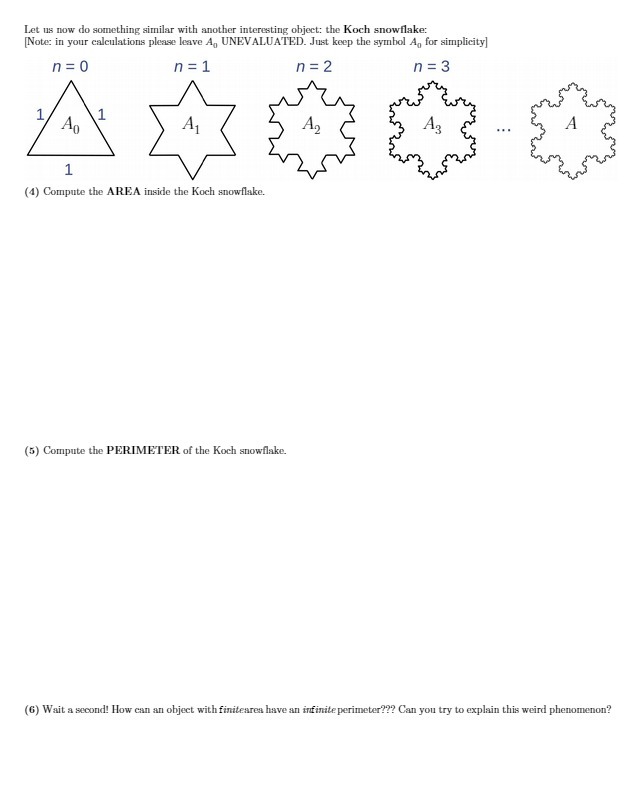
Let us now do something similar with another interesting object: the Koch snowflake: Note: in your calculations please leave A, UNEVALUATED. Just keep the symbol A, for simplicity] n= 0 n = 1 n = 2 n = 3 A1 1 (4) Compute the AREA inside the Koch snowflake. (5) Compute the PERIMETER of the Koch snowflake. (6) Wait a second! How can an object with finitearea have an infinite perimeter??? Can you try to explain this weird phenomenon
Step by Step Solution
There are 3 Steps involved in it
1 Expert Approved Answer
Step: 1 Unlock

Question Has Been Solved by an Expert!
Get step-by-step solutions from verified subject matter experts
Step: 2 Unlock
Step: 3 Unlock
 Study Help