







Question: Let V and V' be vector spaces over a field k (that is, V and V' are k-modules). A function f : V - V'
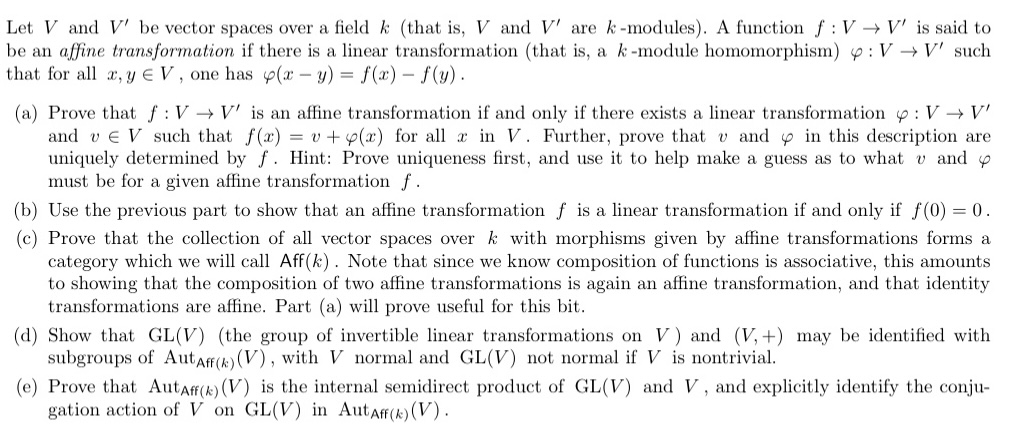
Let V and V' be vector spaces over a field k (that is, V and V' are k-modules). A function f : V - V' is said to be an affine transformation if there is a linear transformation (that is, a k-module homomorphism) 4 : V - V' such that for all a, y E V , one has 4(x -y) = f(x) - f(y) . (a) Prove that f : V - V' is an affine transformation if and only if there exists a linear transformation 4 : V - V' and v E V such that f(x) = v+(x) for all a in V. Further, prove that v and 4 in this description are uniquely determined by f . Hint: Prove uniqueness first, and use it to help make a guess as to what v and y must be for a given affine transformation f . (b) Use the previous part to show that an affine transformation f is a linear transformation if and only if f(0) = 0. (c) Prove that the collection of all vector spaces over k with morphisms given by affine transformations forms a category which we will call Aff() . Note that since we know composition of functions is associative, this amounts to showing that the composition of two affine transformations is again an affine transformation, and that identity transformations are affine. Part (a) will prove useful for this bit. (d) Show that GL(V) (the group of invertible linear transformations on V ) and (V, +) may be identified with subgroups of AutAff(k) (V) , with V normal and GL(V) not normal if V is nontrivial. (e) Prove that AutAff() (V) is the internal semidirect product of GL(V) and V , and explicitly identify the conju- gation action of V on GL(V) in AutAff(k) (V)
Step by Step Solution
There are 3 Steps involved in it

Get step-by-step solutions from verified subject matter experts
 Study Help