







Question: Let X be a random variable taking values in the finite interval [0, c]. You may assume that X is discrete, though this is not
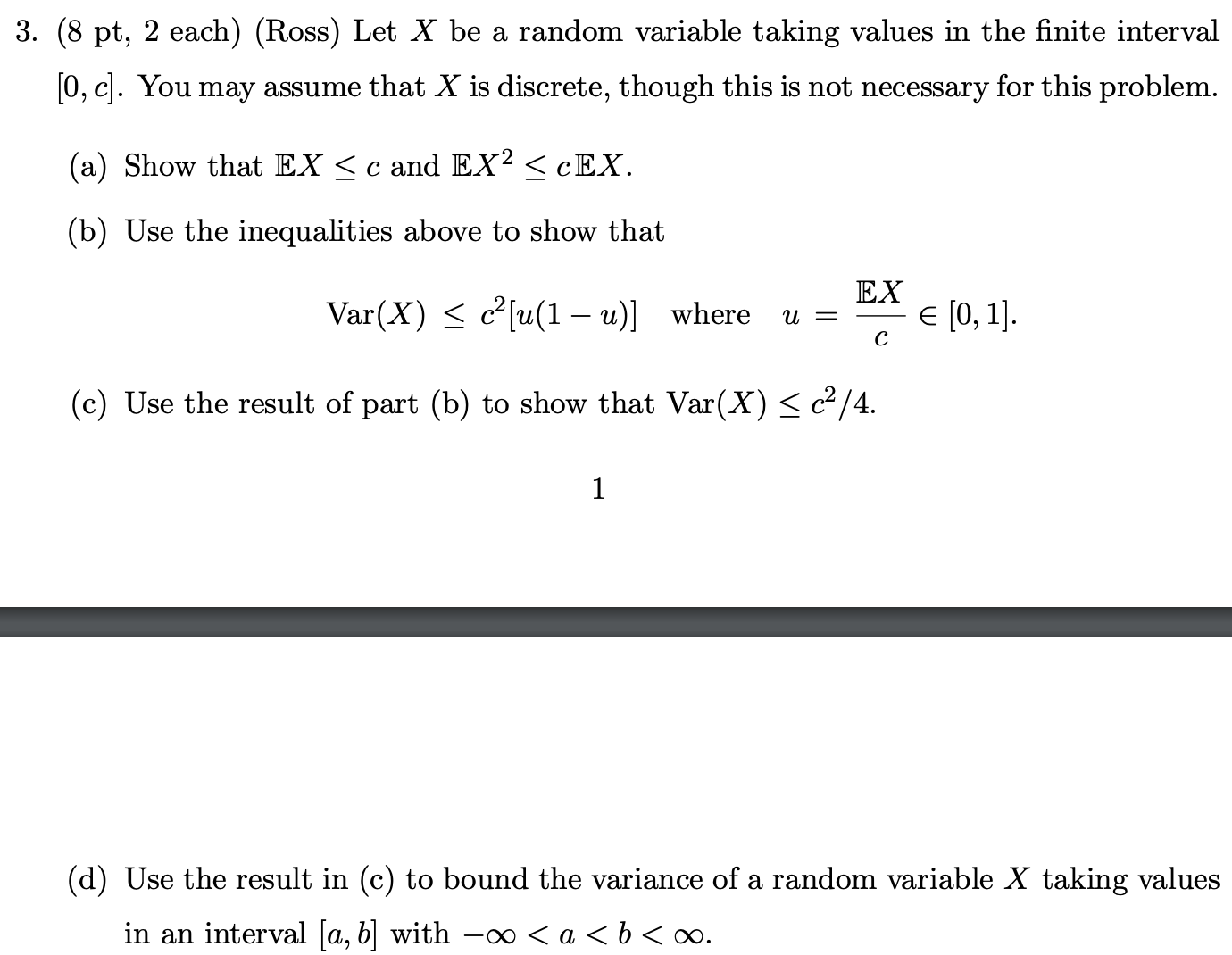
Let X be a random variable taking values in the finite interval [0, c]. You may assume that X is discrete, though this is not necessary for this problem.
(a) Show that EX ? c and EX2 ? c EX.
(b) Use the inequalities above to show that Var(X) ? c 2 [u(1 ? u)] where u = EX c ? [0, 1].
(c) Use the result of part (b) to show that Var(X) ? c 2/4. 1
(d) Use the result in (c) to bound the variance of a random variable X taking values in an interval [a, b] with ??
3. (8 pt, 2 each) (Ross) Let X be a random variable taking values in the nite interval [0, c]. You may assume that X is discrete, though this is not necessary for this problem. (a) Show that EX 5 c and ]EX2 3 clEX. (b) Use the inequalities above to show that Var(X) S c2[u(1 u)] where u = g 6 [0,1]. (c) Use the result of part (b) to show that Var(X) S 62/4. (d) Use the result in (c) to bound the variance of a random variable X taking values in an interval [(1, b] with 00
Step by Step Solution
There are 3 Steps involved in it

Get step-by-step solutions from verified subject matter experts
 Study Help