







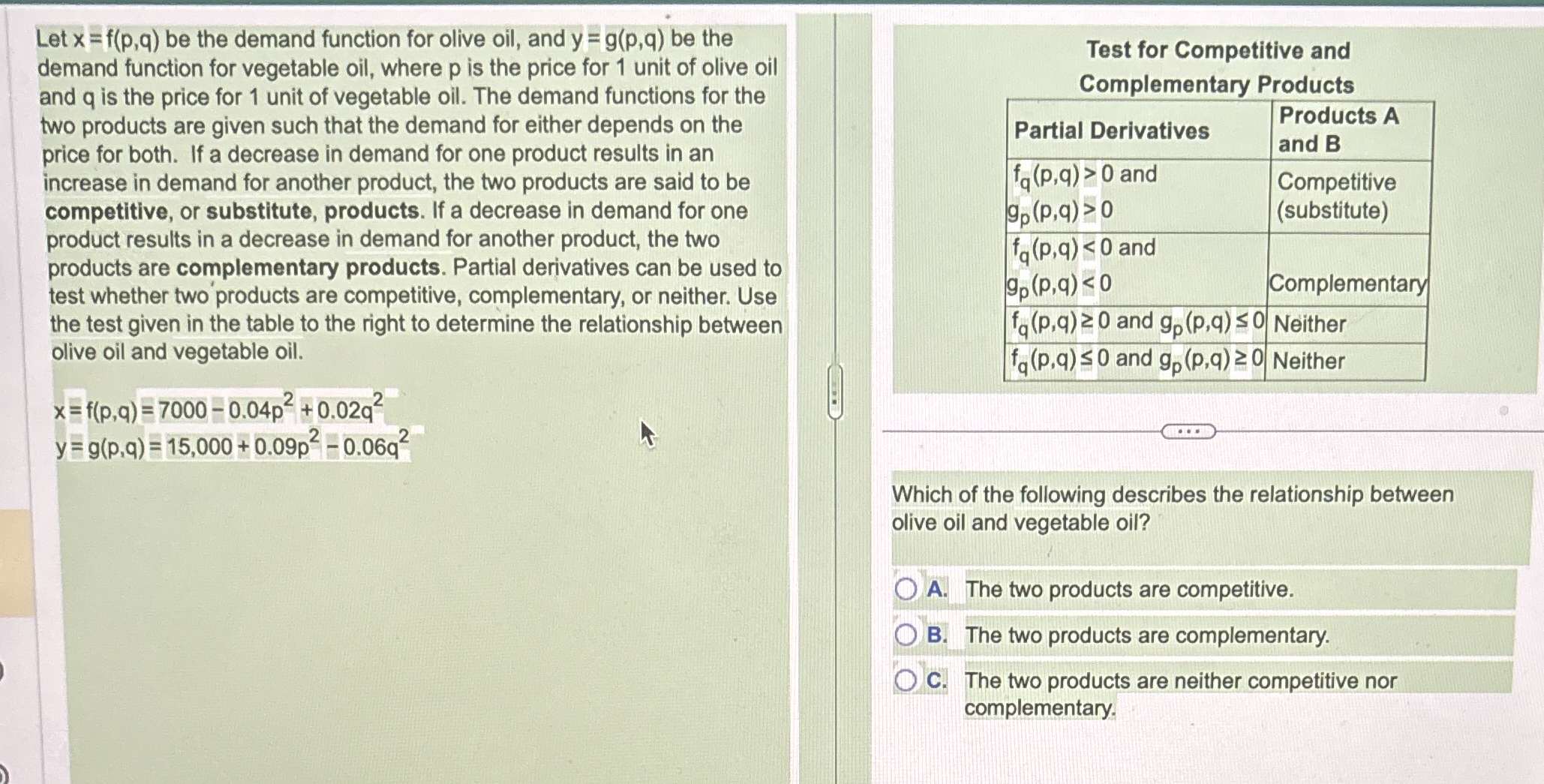
Question: Let x = f ( p , q ) be the demand function for olive oil, and y = g ( p , q )
Let be the demand function for olive oil, and be the demand function for vegetable oil, where is the price for unit of olive oil and q is the price for unit of vegetable oil. The demand functions for the two products are given such that the demand for either depends on the price for both. If a decrease in demand for one product results in an increase in demand for another product, the two products are said to be competitive, or substitute, products. If a decrease in demand for one product results in a decrease in demand for another product, the two products are complementary products. Partial derivatives can be used to test whether two products are competitive, complementary, or neither. Use the test given in the table to the right to determine the relationship between olive oil and vegetable oil.
Test for Competitive and
Complementary Products
tablePartial Derivatives,tableProducts Aand B and,Competitivesubstitute and,Complementary and Neither and Neither
Which of the following describes the relationship between olive oil and vegetable oil?
A The two products are competitive.
B The two products are complementary.
C The two products are neither competitive nor complementary.
Step by Step Solution
There are 3 Steps involved in it
1 Expert Approved Answer
Step: 1 Unlock

Question Has Been Solved by an Expert!
Get step-by-step solutions from verified subject matter experts
Step: 2 Unlock
Step: 3 Unlock
 Study Help