







Question: Let X = {XnineN be a simple symmetric random walk (SSRW). 1.1 (3 points) Find the distribution of the product X1X2X3. 1.2 (2 points) Compute
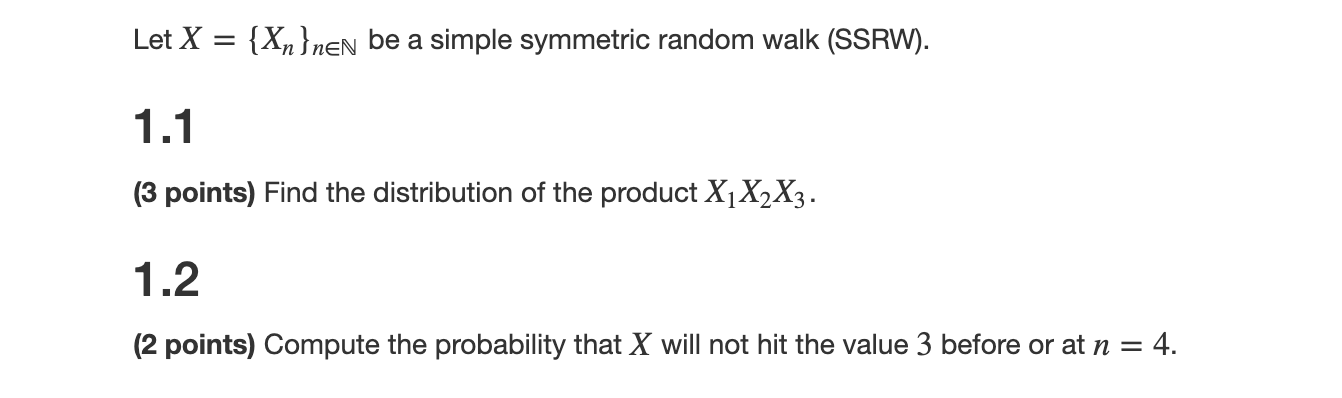

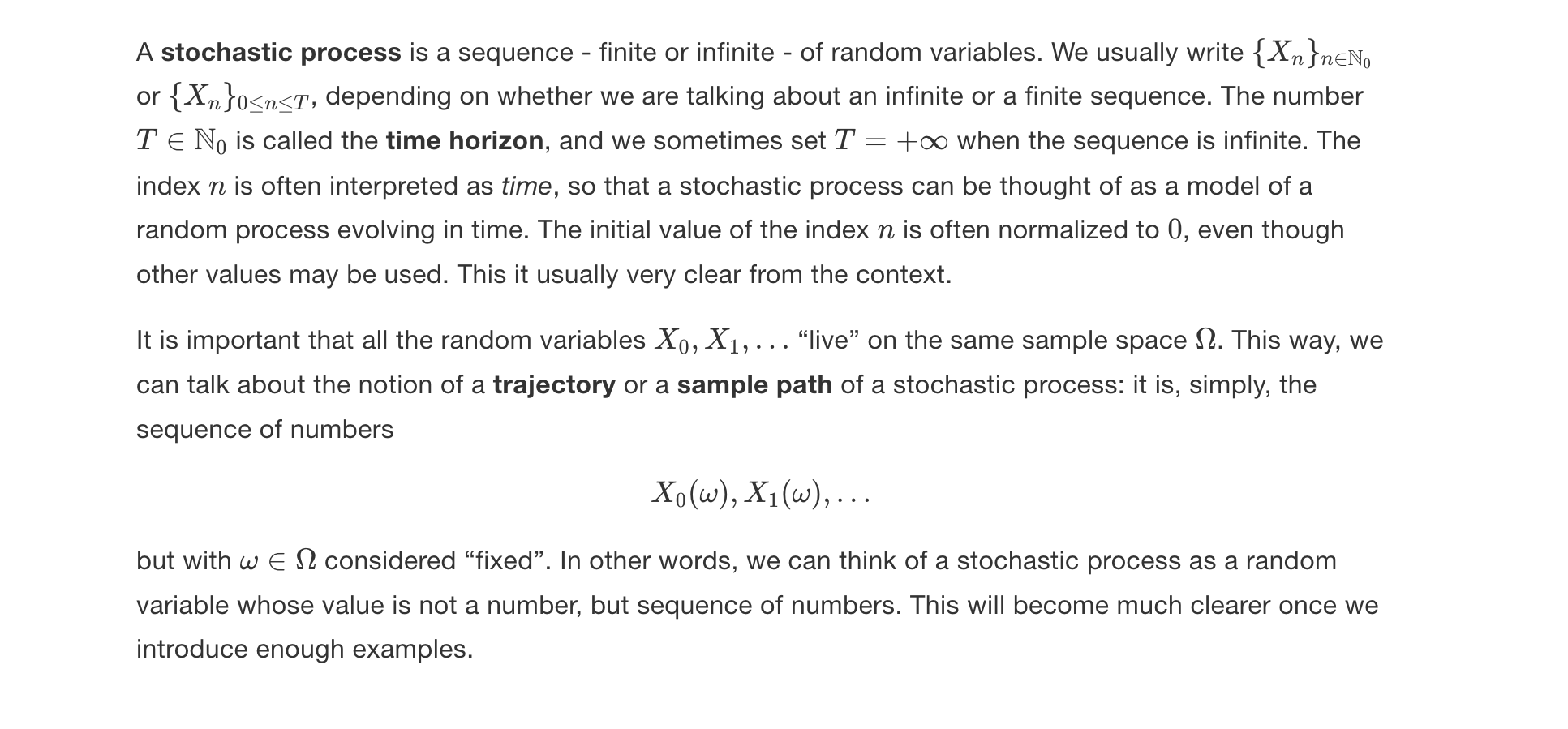
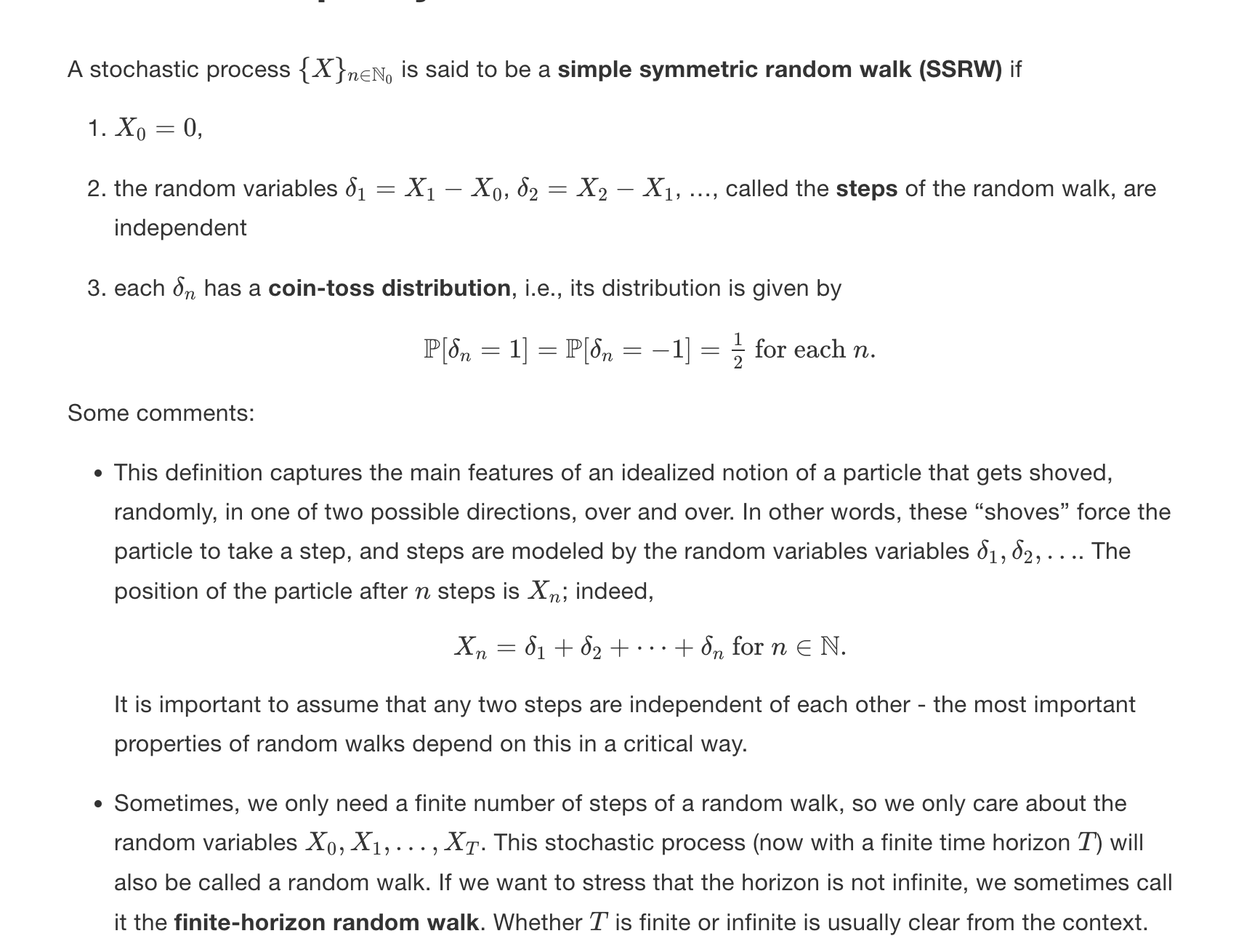
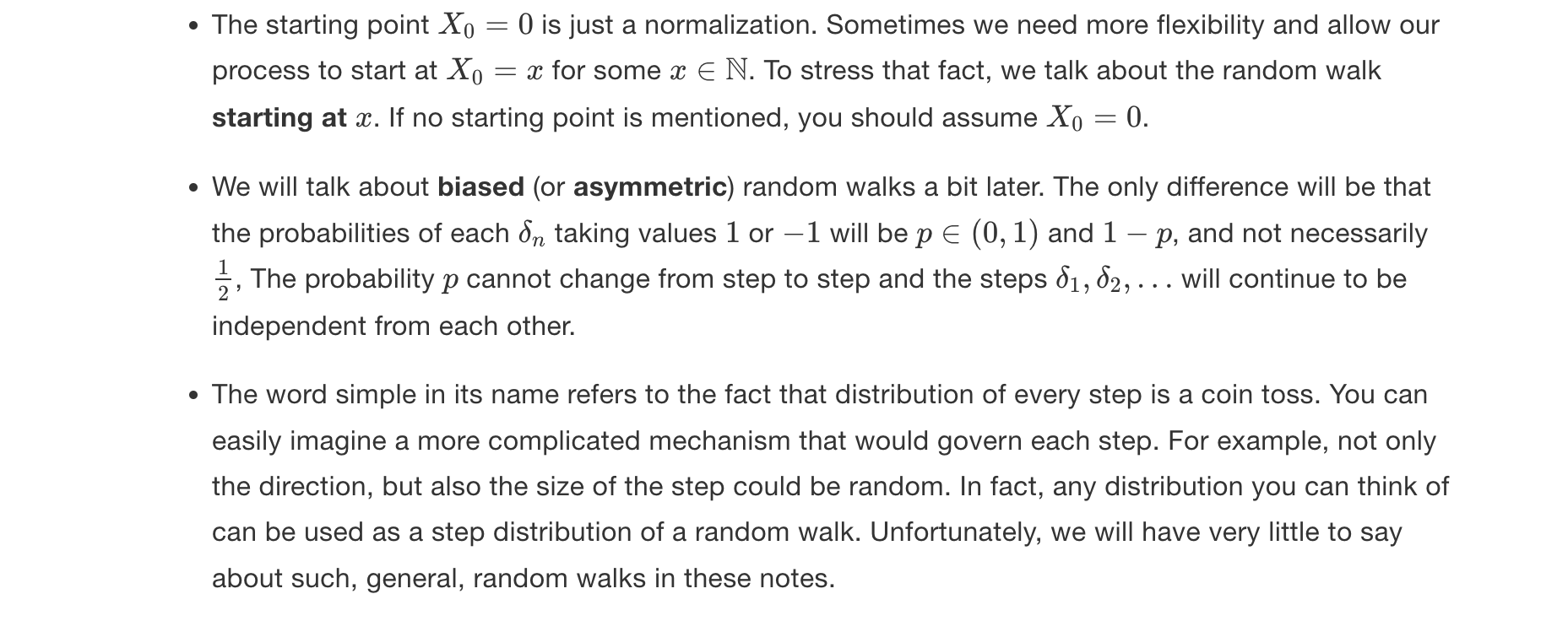
Let X = {XnineN be a simple symmetric random walk (SSRW). 1.1 (3 points) Find the distribution of the product X1X2X3. 1.2 (2 points) Compute the probability that X will not hit the value 3 before or at n = 4.\fA stochastic process is a sequence finite or infinite of random variables. We usually write {Xn}neNO or {19309512 depending on whether we are talking about an infinite or a finite sequence. The number T E No is called the time horizon, and we sometimes set T : +00 when the sequence is infinite. The index n is often interpreted as time, so that a stochastic process can be thought of as a model of a random process evolving in time. The initial value of the index n is often normalized to 0, even though other values may be used. This it usually very clear from the context. It is important that all the random variables X0, X1, . .. \"live\" on the same sample space S]. This way, we can talk about the notion of a trajectory or a sample path of a stochastic process: it is, simply, the sequence of numbers X0(LLJ),X1(UJ), . . . but with w E (2 considered \"fixed". In other words, we can think of a stochastic process as a random variable whose value is not a number, but sequence of numbers. This will become much clearer once we introduce enough examples. A stochastic process {X}7'1EN0 is said to be a simple symmetric random walk (SSRW) if 1. X0 2 0, 2. the random variables 61 : X1 X0, 62 : X2 X1, called the steps of the random walk, are independent 3. each (5,, has a coin-toss distribution, i.e., its distribution is given by PM\" = 1] : M5,, = 1] = % for each n. Some comments: . This definition captures the main features of an idealized notion of a particle that gets shoved, randomly, in one of two possible directions, over and over. In other words, these \"shoves\" force the particle to take a step, and steps are modeled by the random variables variables 61, 62, . . .. The position of the particle after n steps is Xn; indeed, Xn:61+62+"'+6nfOI'TLEN. It is important to assume that any two steps are independent of each other the most important properties of random walks depend on this in a critical way. . Sometimes, we only need a finite number of steps of a random walk, so we only care about the random variables X0, X1, . . . , XT. This stochastic process (now with a finite time horizon T) will also be called a random walk. If we want to stress that the horizon is not infinite, we sometimes call it the finite-horizon random walk. Whether T is finite or infinite is usually clear from the context. - The starting point X0 = D is just a normalization. Sometimes we need more flexibility and allow our process to start at X0 = w for some :5 E N. To stress that fact, we talk about the random walk starting at .13. If no starting point is mentioned, you should assume X0 = 0. - We will talk about biased (or asymmetric) random walks a bit later. The only difference will be that the probabilities of each (in taking values 1 or 1 will be p E (0, 1) and 1 p, and not necessarily %, The probability p cannot change from step to step and the steps 51, 62, . . . will continue to be independent from each other. - The word simple in its name refers to the fact that distribution of every step is a coin toss. You can easily imagine a more complicated mechanism that would govern each step. For example, not only the direction, but also the size of the step could be random. In fact, any distribution you can think of can be used as a step distribution of a random walk. Unfortunately, we will have very little to say about such, general, random walks in these notes
Step by Step Solution
There are 3 Steps involved in it

Get step-by-step solutions from verified subject matter experts
 Study Help