







Question: Let (x_(1),Y_(1)),(x_(2),Y_(2)),dots,(x_(n),Y_(n)) be a random sample from a bivariate normal distribution where x_(i) and Y_(i) are independent such that x_(i)N(mu _(i),phi ) and Y_(i)N(mu _(i),phi
Let
(x_(1),Y_(1)),(x_(2),Y_(2)),dots,(x_(n),Y_(n))be a random sample from a bivariate normal distribution where\
x_(i)and
Y_(i)are independent such that\
x_(i)N(\\\\mu _(i),\\\\phi ) and Y_(i)N(\\\\mu _(i),\\\\phi )\ Note that each pair
(x_(i),Y_(i))has a different mean,
\\\\mu _(i), but all pairs share a common variance,
\\\\phi .\ a) Find the MLEs of the parameters,
(\\\\theta ,\\\\phi )where
\\\\theta =(\\\\mu _(1),dots,\\\\mu _(n)),-\\\\infty , and\
\\\\phi >0. (Express these in terms of
x_(i) and
Y_(i).)\ b) Find the expected values of the
hat(\\\\mu )_(i). Compare this to
\\\\theta .\ c) Find the expected value of
hat(\\\\phi ). Why is this not equal to
\\\\phi ?
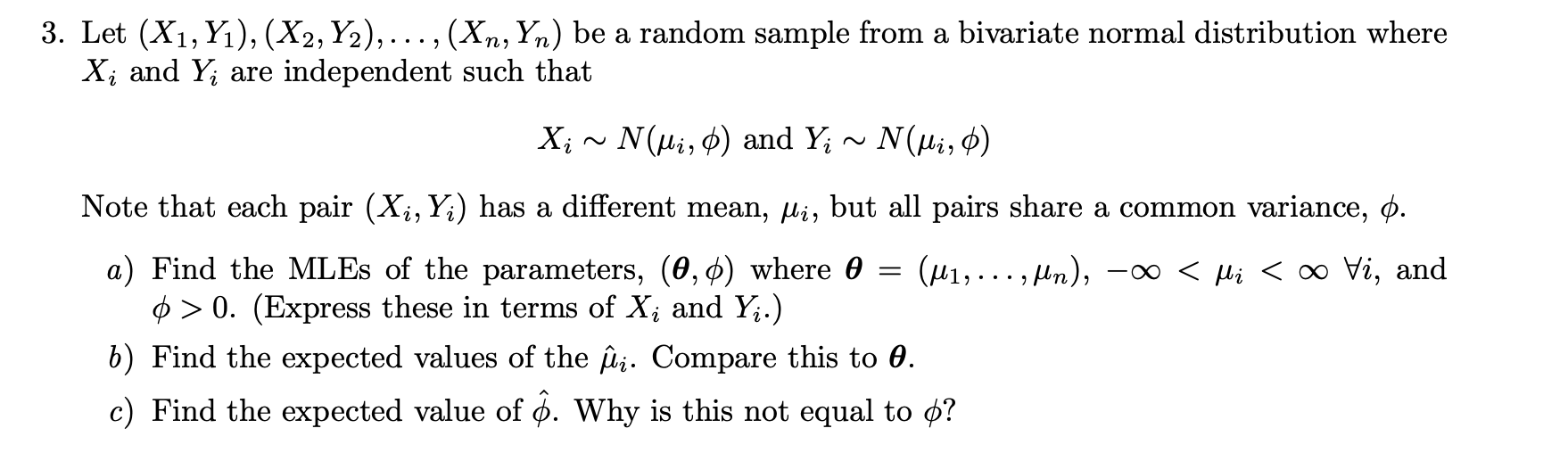
Let (X1,Y1),(X2,Y2),,(Xn,Yn) be a random sample from a bivariate normal distribution where Xi and Yi are independent such that XiN(i,)andYiN(i,) Note that each pair (Xi,Yi) has a different mean, i, but all pairs share a common variance, . a) Find the MLEs of the parameters, (,) where =(1,,n),0. (Express these in terms of Xi and Yi.) b) Find the expected values of the ^i. Compare this to . c) Find the expected value of ^. Why is this not equal to
Step by Step Solution
There are 3 Steps involved in it

Get step-by-step solutions from verified subject matter experts
 Study Help