







Question: Let z be a real valued function of variables x and y. (a) Prove that z forms an exact differential when expressed in differential
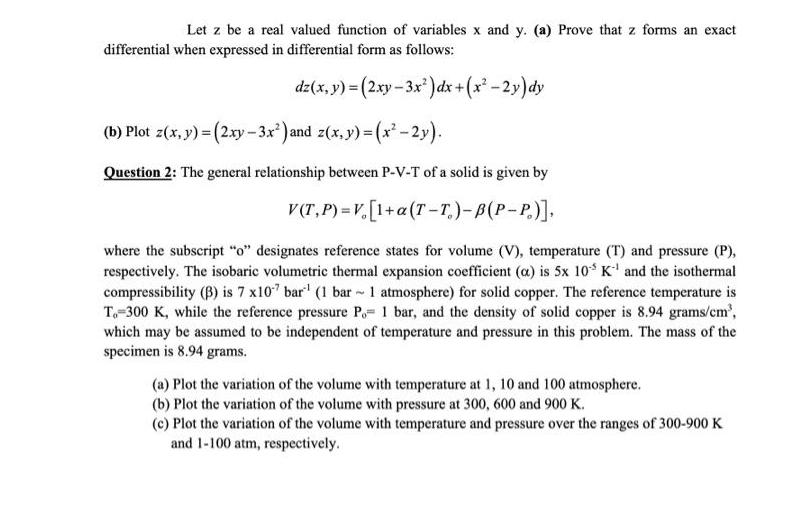
Let z be a real valued function of variables x and y. (a) Prove that z forms an exact differential when expressed in differential form as follows: dz(x, y) = (2xy-3x) dx + (x -2y) dy (b) Plot z(x, y) = (2xy-3x) and z(x, y) = (x-2y). Question 2: The general relationship between P-V-T of a solid is given by V(T,P) = V [1+a (T-T.)-B(P-P.)], where the subscript "o" designates reference states for volume (V), temperature (T) and pressure (P), respectively. The isobaric volumetric thermal expansion coefficient (a) is 5x 10 K- and the isothermal compressibility (B) is 7 x10⁷ bar (1 bar 1 atmosphere) for solid copper. The reference temperature is T. 300 K, while the reference pressure P= 1 bar, and the density of solid copper is 8.94 grams/cm, which may be assumed to be independent of temperature and pressure in this problem. The mass of the specimen is 8.94 grams. (a) Plot the variation of the volume with temperature at 1, 10 and 100 atmosphere. (b) Plot the variation of the volume with pressure at 300, 600 and 900 K. (c) Plot the variation of the volume with temperature and pressure over the ranges of 300-900 K and 1-100 atm, respectively.
Step by Step Solution
3.46 Rating (162 Votes )
There are 3 Steps involved in it
Answer z must demonstrate that its total differential forms an exact differential in order for us to ... View full answer

Get step-by-step solutions from verified subject matter experts
 Study Help