







Question: Let's say, the relation R=(A, B, C, D) with F.D. = {AB, DA, AC} is decomposed into: 1. R1(A, B, C) and R2(A, D).
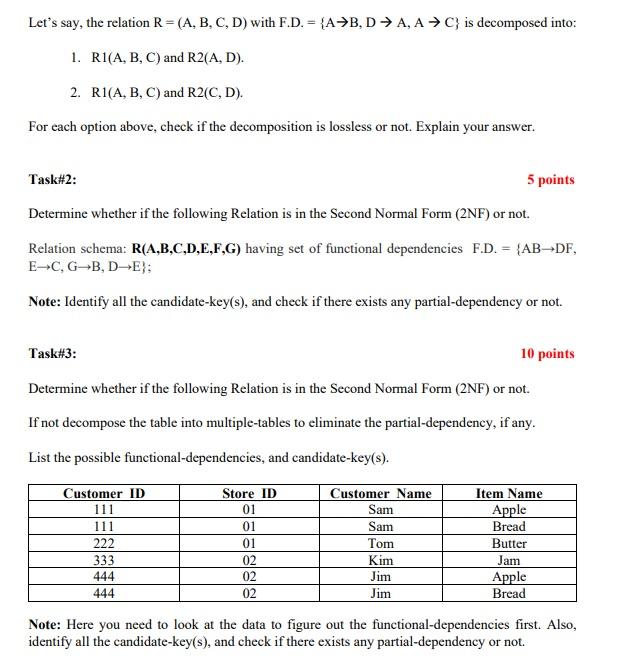
Let's say, the relation R=(A, B, C, D) with F.D. = {AB, DA, AC} is decomposed into: 1. R1(A, B, C) and R2(A, D). 2. R1(A, B, C) and R2(C, D). For each option above, check if the decomposition is lossless or not. Explain your answer. Task#2: 5 points Determine whether if the following Relation is in the Second Normal Form (2NF) or not. Relation schema: R(A,B,C,D,E,F,G) having set of functional dependencies F.D. = {ABDF, EC, GB, DE}; Note: Identify all the candidate-key(s), and check if there exists any partial-dependency or not. Task#3: 10 points Determine whether if the following Relation is in the Second Normal Form (2NF) or not. If not decompose the table into multiple-tables to eliminate the partial-dependency, if any. List the possible functional-dependencies, and candidate-key(s). Customer ID 111 111 222 333 444 444 Store ID 01 01 01 02 02 02 Customer Name Sam. Sam Tom Kim Jim Jim Item Name Apple Bread Butter Jam Apple Bread Note: Here you need to look at the data to figure out the functional-dependencies first. Also, identify all the candidate-key(s), and check if there exists any partial-dependency or not.
Step by Step Solution
There are 3 Steps involved in it

Get step-by-step solutions from verified subject matter experts
 Study Help