







Question: Let's say you need to break a code that uses a basic block cipher, and breaking this particular code isn't illegal, immoral, or unethical. You
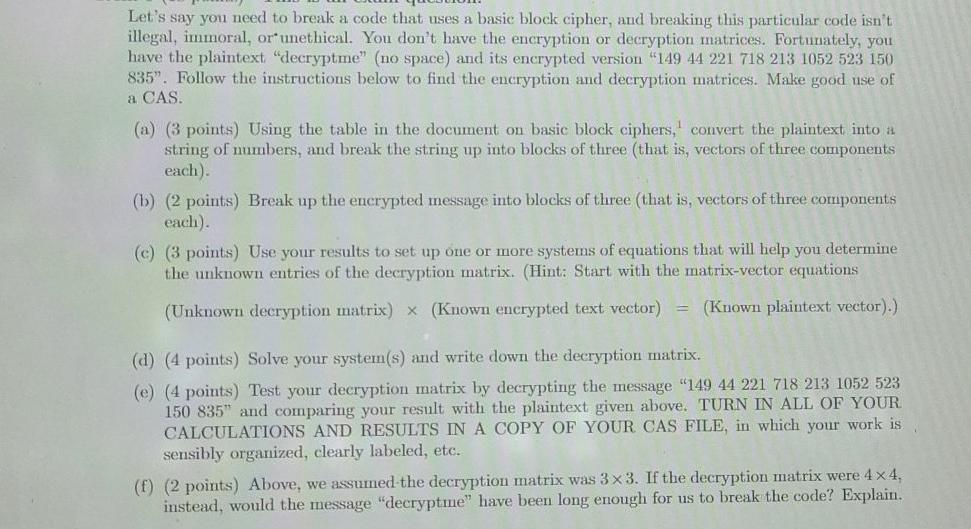
Let's say you need to break a code that uses a basic block cipher, and breaking this particular code isn't illegal, immoral, or unethical. You don't have the encryption or decryption matrices. Fortunately, you have the plaintext "decryptme (no space) and its encrypted version "149 44 221 718 213 1052 523 150 835". Follow the instructions below to find the encryption and decryption matrices. Make good use of a CAS. (a) (3 points) Using the table in the document on basic block ciphers, convert the plaintext into a string of numbers, and break the string up into blocks of three (that is, vectors of three components each) (b) (2 points) Break up the encrypted message into blocks of three (that is, vectors of three components each) (c) (3 points) Use your results to set up one or more systems of equations that will help you determine the unknown entries of the decryption matrix. (Hint: Start with the matrix-vector equations (Unknown decryption matrix) * (Known encrypted text vector) (Known plaintext vector).) (d) (4 points) Solve your system(s) and write down the decryption matrix. (e) (4 points) Test your decryption matrix by decrypting the message "149 44 221 718 213 1052 523 150 835" and comparing your result with the plaintext given above. TURN IN ALL OF YOUR CALCULATIONS AND RESULTS IN A COPY OF YOUR CAS FILE, in which your work is sensibly organized, clearly labeled, etc. (f) (2 points) Above, we assumed the decryption matrix was 3 x 3. If the decryption matrix were 4 x 4. instead, would the message "decryptme" have been long enough for us to break the code? Explain
Step by Step Solution
There are 3 Steps involved in it

Get step-by-step solutions from verified subject matter experts
 Study Help